
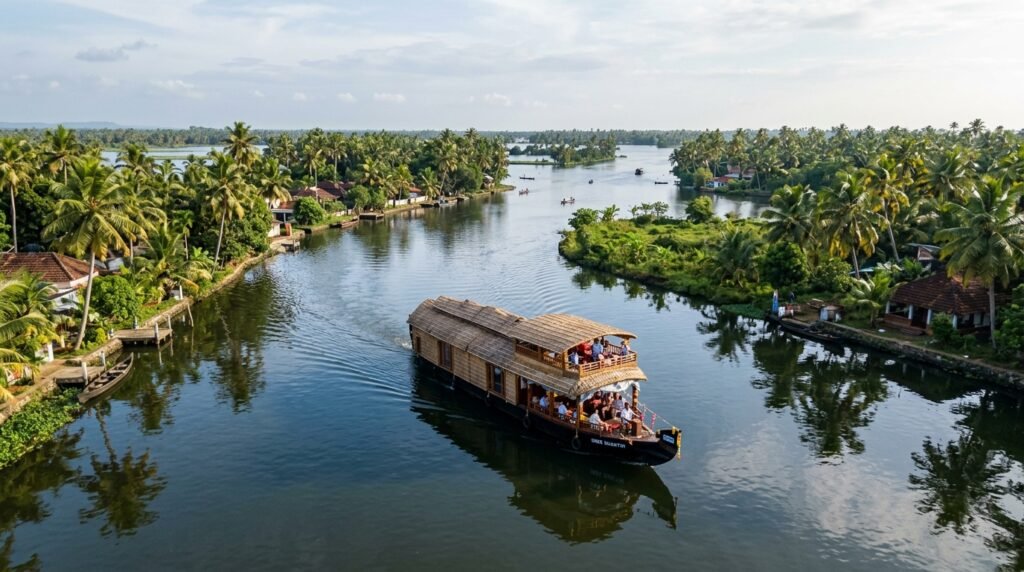
The first thing you notice is the quiet. Once the houseboat leaves the jetty and the engine settles into a low hum, Alleppey’s backwaters take over — palm-lined canals, paddy fields stretching to the horizon, and the occasional cheena vala tilting over the water as a fisherman tends his nets. A houseboat trip in Alappuzha is one of those travel experiences that actually lives up to what the photographs promise. Here is everything you need to know to plan it well.
Key Insights
- A houseboat trip in Alleppey is a cruise on a kettuvallam — a traditional wooden vessel tracing its origins to Kerala’s ancient rice-trading waterways — through the backwaters between Vembanad Lake and the Kuttanad canal network
- Overnight stays (noon check-in to 9am check-out) are the recommended format; day cruises suit travellers with tight itineraries
- Prices range from ₹8,000–₹12,000 for a day cruise to ₹10,000–₹35,000+ for an overnight stay, depending on category and season
- The best time to go is October to March; August brings the Nehru Trophy Snake Boat Race — extraordinary to witness, but book months ahead
- Houseboats anchor at around 6pm and don’t move again until morning — the anchored evening is a genuine part of the experience, not a limitation
What Is a Houseboat Trip in Alleppey?
An Alleppey houseboat trip is a cruise through the Kerala backwaters on a kettuvallam — a traditional wooden vessel that once carried rice and spices through the Kuttanad waterways, and now carries travellers through the same canals. The word itself tells the story: kettu means to tie or knot, and vallam means boat. Traditionally, kettuvallam were built without a single nail, the planks interlocked and bound with coconut coir rope — a method that gives the vessel a natural flex on the water. Modern houseboats blend this heritage with contemporary construction, but the design and the unhurried character of the boat remain unchanged.
Today, around 700 houseboats operate in the Alleppey and Kumarakom area — the largest concentration in Kerala. They range from functional one-bedroom boats with a modest deck to multi-bedroom luxury vessels with teak interiors and open-air sundecks. What they all share is a three-person crew, freshly cooked Kerala meals, and a pace of travel that is entirely unlike anything on land.
Day Cruise vs Overnight Stay — Which Should You Choose?
For most travellers, an overnight stay is the better choice — it includes all meals, costs less per hour of experience than a day cruise, and gives you the anchored evening on the water that is often the most memorable part of the trip. A day cruise suits those with tight itineraries. Here is the honest breakdown of both.
The Day Cruise
A day cruise runs for 5–6 hours, with most boats departing between 11am and noon and returning to the jetty by late afternoon. Lunch is included. It suits travellers with a tight Kerala itinerary, those combining the backwaters with a hotel or resort stay, or anyone who wants a first taste of the waterways without committing to a full night. If you have one afternoon in Alleppey and the next morning elsewhere, a day cruise is the sensible choice.
Typical day cruise schedule:
- 11:00am — Check-in at jetty; welcome drink on board
- 11:30am — Depart; cruise through canals toward Punnamada Lake
- 1:00pm — Lunch served on board
- 1:30–4:30pm — Continue cruising through the backwaters
- 4:30–5:00pm — Return to jetty; check-out
The Overnight Stay
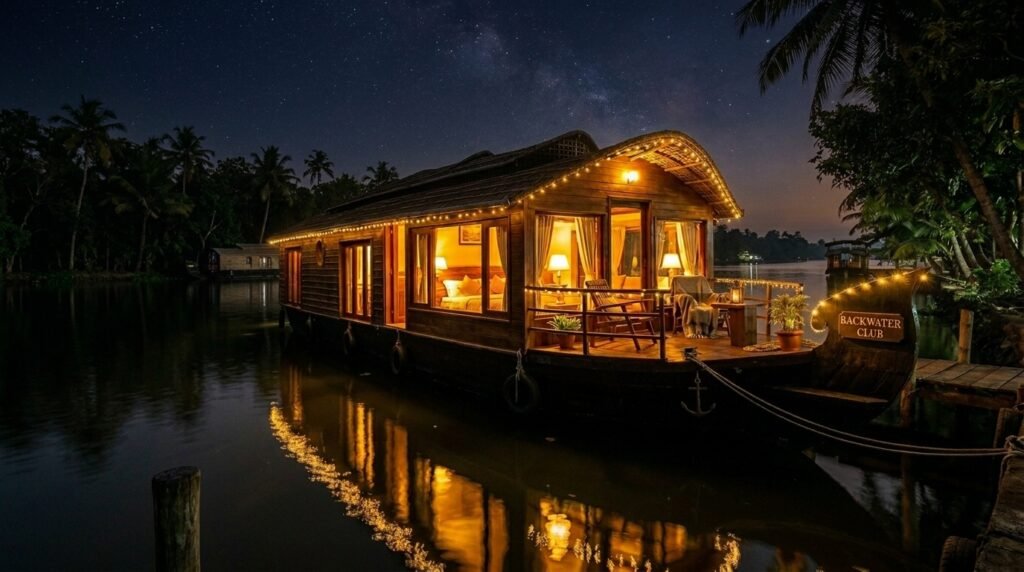
An overnight package runs from noon check-in to approximately 9am check-out — around 21 hours in total. But here is what most guides don’t tell you: actual cruising time is only 6–7 hours. Houseboats anchor at around 6pm and don’t cruise again until 7:30–8am. That leaves roughly 13 hours stationary.
This is not a flaw. The anchored evening on an Alappuzha backwater is one of the best parts of the trip — the engine stops, the light turns gold over the paddy fields, dinner is served on the sundeck, and the only sounds are frogs, crickets, and the occasional splash from the bank. Understanding this upfront means you arrive with the right expectations. The overnight stay is better value in every way that matters: all meals are included, you experience both the afternoon cruise and the soft morning light on the water, and the total cost per hour of experience is significantly lower than a day cruise.
Typical overnight schedule:
- 12:00 noon — Check-in at jetty; welcome drink on board
- 12:30pm — Depart; cruise through canals and across Punnamada Lake
- 1:30pm — Lunch served on board
- 2:00–5:30pm — Continue cruising through the backwaters
- 5:30–6:00pm — Anchor near a village or canal bank
- 6:30pm — Evening tea and snacks on the sundeck
- 8:00–9:00pm — Dinner served on board
- 7:30am — Brief morning cruise (approximately 1.5–2 hours)
- 9:00am — Return to jetty; check-out
The Night Stay (Evening Only)
A less commonly known third option, offered by many operators, is the night stay: board at 5:30pm, cruise briefly to an anchoring spot, have dinner on board, sleep in the AC bedroom, and enjoy a 2-hour morning cruise before checking out at 9am. No lunch or afternoon cruise is included. This suits travellers who are already based in Alleppey, want the houseboat experience as an evening rather than a full day, or simply prefer to spend the afternoon elsewhere and join the boat at dusk.
Typical night stay schedule:
- 5:30pm — Check-in at jetty
- 6:00–7:00pm — Short cruise to anchoring spot
- 7:00pm — Anchor; evening on the sundeck
- 8:00–9:00pm — Dinner served on board
- Night — AC bedroom
- 7:30am — Morning cruise (approximately 2 hours)
- 9:00am — Return to jetty; check-out
| Day Cruise | Night Stay | Overnight Stay | |
|---|---|---|---|
| Duration | 5–6 hours | ~15.5 hours (5:30pm to 9am) | ~21 hours (noon to 9am) |
| Actual cruising time | 5–6 hours | ~3 hours | ~6–7 hours |
| Meals included | Lunch | Dinner, breakfast | Lunch, tea, dinner, breakfast |
| Best for | Tight itineraries | Evening experience | Full backwater experience |
| Starting price (1 bedroom) | ~₹8,000–₹12,000 | ~₹7,000–₹10,000 | ~₹10,000–₹18,000 |
Alleppey Houseboat Prices in 2026
Alleppey houseboat prices range from approximately ₹8,000 for a basic day cruise to ₹35,000+ per night for a luxury multi-bedroom boat. What you pay depends on category, duration, season, and — crucially — how you book.
What the Three Tiers Actually Mean
Deluxe is the entry-level category: a functional bedroom with an attached bathroom, air conditioning (at night only), an onboard chef, and a covered sitting area. Day cruise from ~₹8,000–₹12,000; overnight from ~₹10,000–₹18,000. These are per-boat rates for a 1-bedroom; multi-bedroom boats are priced higher. One important caveat: “deluxe” is not a standardised label across operators. Quality varies considerably. Always request photos of the actual boat before confirming.
Premium offers better fit and finish — larger bedrooms, improved deck space, typically newer or better-maintained boats. Overnight stays from ~₹15,000–₹22,000.
Luxury means fully furnished interiors, quality linen, teak or hardwood finishes, larger sundecks, and in some cases premium amenities. Overnight from ~₹22,000–₹35,000+. Multi-bedroom luxury boats for groups and families sit at the higher end of this range. Peak season (December–January) adds 20–30% across all categories. Weekday trips are consistently cheaper than weekends.
Direct Booking vs OTA
Booking directly with a local Alleppey operator will almost always get you a better boat at a better price than booking through MakeMyTrip, GetYourGuide, or Booking.com. OTA platforms add 10–20% commission, which typically means either a higher price or boats that didn’t sell through direct channels.
When booking direct, look for an operator with a working phone number and WhatsApp contact, recent reviews on Google that mention the crew by name, and photographs of the specific boat you will be on — not promotional stock images. These three things tell you almost everything.
You can book your houseboat trip via Backwater Club, for the best routes, experience, boat & service.
What’s Included in an Alleppey Houseboat Package
A standard Alleppey houseboat package includes all meals, exclusive use of the boat, and a three-person crew. Here is what that looks like in practice.
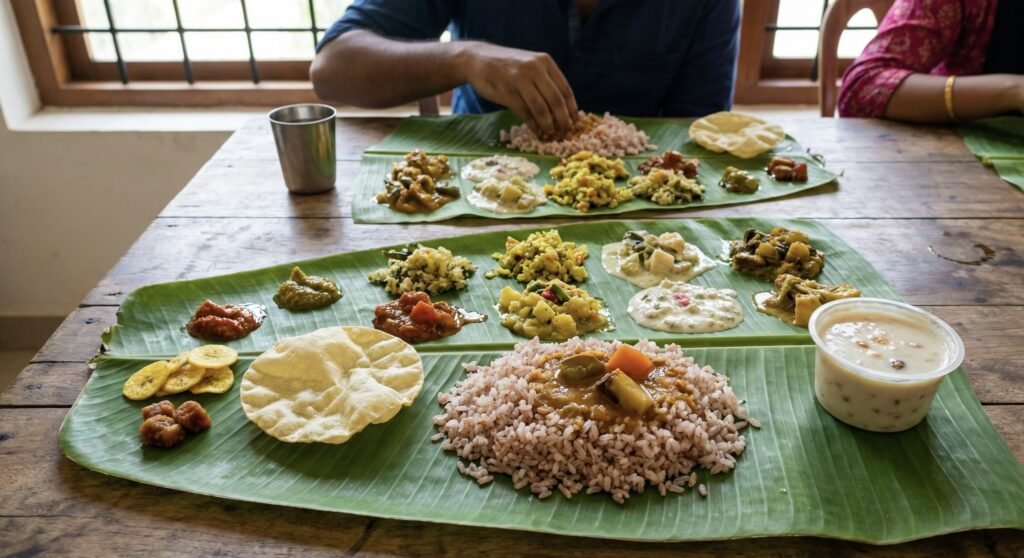
Meals begin with lunch on arrival: a full Kerala spread of rice, fish curry, vegetable dishes, coconut chutney, papadam, and fresh fish fry. Evening tea and snacks arrive on the sundeck as the light fades. Dinner is served after anchoring — typically Kerala non-veg with rice or appam, though vegetarian menus are always available. Specify your preference when booking. Breakfast before check-out is simple: idli, egg, or bread with tea. The food on well-run Alleppey houseboats is genuinely excellent — locally sourced fish, fresh vegetables, and Kerala spicing that is hard to find in a restaurant setting.
Crew consists of a captain, a chef, and an assistant. Three people are with you throughout the trip. Couples should know this in advance — the crew are professional and discreet, but they are present and visible. On quality operators, the crew elevates the experience: a good captain will point out the cheena vala fishing nets, explain the toddy tapping happening along the bank, and give you a sense of local life rather than a packaged tour.
Air conditioning in the bedroom operates only when the generator runs at night — typically from around 9pm to 6am. During the afternoon cruise, the open deck, covered seating, and canal breeze are where you’ll want to spend time anyway.
The anchored evening runs from around 6pm until morning. This is the time for tea on the sundeck, watching the sun set over the backwaters, and dinner under an open sky. If the boat moors near a village, a short walk along the bund is possible. Budget ₹200–₹500 per crew member as a tip at check-out — the captain, chef, and assistant all earn it.
Alleppey Houseboat Routes: What You’ll See on the Water
Most Alleppey houseboats depart from Finishing Point Jetty or the Pallathuruthy boarding area and cruise through the canal network into Punnamada Lake — the broad stretch of Vembanad Lake that serves as the venue for the Nehru Trophy Snake Boat Race each August.
Along the way, the backwater landscape unfolds in a way that no photograph captures completely: cheena vala cantilevered over the canal edges, their bamboo frames dipping and lifting as fishermen tend them; toddy tappers climbing coconut palms to collect kallu — the local fermented palm sap — into earthen pots three times a day; children in school uniforms stepping into country boats at the canal bank; vegetable vendors paddling canoes stacked with produce. These are the micro-moments that define an Alleppey houseboat trip, and they are visible only from the water.
One honest note on Punnamada Lake: during peak season, you will share the open stretch with other houseboats. The setting is undeniably beautiful, but it is a shared experience.
The Kuttanad Route — A Quieter Alleppey
For a less-trafficked and more immersive alternative, ask your operator specifically for a route through the Kuttanad canals — towards Kainakary, Nedumudi, or Champakulam, rather than staying on the open lake. Not all operators will offer this unprompted; asking directly is the key.
Kuttanad is the rice bowl of Kerala — and one of the only places in the world where cultivated farmland sits 1.5 to 3 metres below sea level. The paddy fields are held back from the water by earthen bunds; the land you see from the houseboat is, in geological terms, below the surface of the lake you are floating on. Cruising through Kuttanad on a narrow canal, with the fields at eye level on either side and egrets picking their way through the stubble, is a different experience entirely from the open lake.
Named stops on this route include Kainakary village, Champakulam — where one of Kerala’s oldest churches stands directly on the canal bank — and Nedumudi. On longer routes, Thottappally, where the backwaters meet the sea through a narrow outflow channel, is one of the most memorable endpoints in the region. Near Champakulam, the Karumadikkuttan statue — an ancient Buddha carved from black granite, seated at the water’s edge — is visible from the boat and appears in almost none of the mainstream Alleppey guides.
Best Time for a Houseboat Trip in Alleppey
The best time for a houseboat trip in Alleppey is October to March, when the skies are clear, temperatures are comfortable, and the backwaters are at their most navigable. But the right season depends on what experience you want.
October–March (peak season) offers the best conditions: clear skies, cool evenings on the water, paddy fields golden at harvest in November. This is the busiest period — book 3–4 weeks ahead for weekends and school holidays; prices are highest in December–January.
April–May (pre-monsoon) is hot and humid on land but more manageable on the water, especially on the shaded sections of the canal. Fewer tourists and lower prices with no compromise on the backwater experience itself.
June–September (monsoon) transforms the landscape. The canals fill, the vegetation is intensely green, and rain on the water creates a beauty that the dry season cannot match. Houseboat trips run year-round through the monsoon. June and July are the better months; some narrow canal routes may be restricted in high water, and the open lake can be choppy during heavy rain. The monsoon is genuinely worth considering — not as a compromise, but as a different kind of experience.
August — Nehru Trophy month: The Nehru Trophy Boat Race, known locally as Vallam Kali, takes place on the second Saturday of August at Punnamada Lake. The chundan vallam — snake boats over 100 feet long, driven by 100–150 rowers moving in absolute unison to the beat of traditional chants and drum — make this one of the most extraordinary spectacles in India. Houseboats on and near Punnamada Lake book out months in advance for this weekend, and prices rise sharply. Book extremely early to secure a boat, or avoid the date if a quiet experience is what you are looking for.
How to Choose the Right Houseboat for Your Group
A 1-bedroom houseboat on a narrow Kuttanad canal is a completely different experience from a 3-bedroom vessel on the open Vembanad Lake — and the price difference does not always reflect the experiential difference.
Each bedroom on an Alleppey houseboat comfortably accommodates 2 adults; most operators allow a maximum of 3–4 guests per bedroom. Use this as your guide when choosing the number of bedrooms: a couple needs 1 bedroom, a family of 4–5 needs 2 bedrooms, and a group of 6 or more should look at 3 bedrooms or above.
1 bedroom is the right choice for couples and honeymooners. Smaller boats fit the narrow canal routes that deliver the most intimate backwater experience, and the vast majority of Alleppey’s fleet is 1-bedroom, so availability and pricing are both favourable.
2 bedrooms suits families of four or friends travelling together. More deck space and a second private bedroom; generally limited to the wider waterways rather than narrow canals.
3 bedrooms and above works for larger groups and families. These boats operate mainly on open lake routes; the experience trades intimacy for space. A couple paying for a 3-bedroom boat because it looks more impressive on the brochure is usually paying more for less of what makes the backwaters special.
Before confirming any booking, ask these questions: Can you show me photographs of the actual boat, not stock imagery? What route will we take — can you include Kuttanad canals? What are the AC hours? Can the chef accommodate dietary preferences? Is there a generator for charging devices overnight? The answers — and the speed and specificity with which an operator responds — will tell you what you need to know.
Is a Houseboat Trip in Alleppey Worth It?
Yes — for most travellers, an overnight houseboat trip in Alleppey is worth it. It is one of the few travel experiences in India that delivers what it promises: genuine quietude, exceptional food cooked to order, and a landscape that moves past you at the pace of a slow river. The experience is hard to replicate elsewhere.
It is the right choice for couples and honeymooners, for travellers who value slow and immersive experiences, and for anyone who wants to eat Kerala food at its best while watching the backwater light change from afternoon gold to evening dark. It is less suited to travellers expecting total solitude — three crew members are with you at all times — or to those who need to be active and on the move.
If budget is a constraint, both shikara rides and kayaking give you meaningful access to the Alleppey backwaters at a fraction of the cost. A shikara reaches the narrow canals that houseboats cannot enter; kayaking puts you at water level in the quietest parts of the canal network. Neither replaces the overnight houseboat experience, but either makes for a genuinely worthwhile alternative or addition to your Alleppey itinerary.
Frequently Asked Questions About Alleppey Houseboat Trips
How long is a houseboat trip in Alleppey?
There are three formats. A day cruise runs 5–6 hours (noon to ~5pm). A night stay runs from 5:30pm to 9am the next morning, with a 2-hour morning cruise included. A full overnight stay covers approximately 21 hours (noon check-in to 9am check-out) with 6–7 hours of actual cruising — the boat anchors at around 6pm and the anchored evening is a genuine part of the experience, not wasted time.
How much does a houseboat trip in Alleppey cost?
Day cruises start at approximately ₹8,000–₹12,000 for a 1-bedroom deluxe boat. Night stay packages typically range from ₹7,000–₹10,000. Overnight stays range from ₹10,000–₹18,000 (deluxe) to ₹22,000–₹35,000+ (luxury). Peak season adds 20–30% across categories. Booking directly with a local operator typically saves 10–20% compared to booking through OTA platforms.
What is the best time for a houseboat trip in Alleppey?
October to March offers the best conditions — clear skies, cooler temperatures, and calm water. August is the month for the Nehru Trophy Snake Boat Race on Punnamada Lake, which is extraordinary to witness but requires booking months in advance. Monsoon (June–September) is viable and atmospheric, with June–July the better window.
Which is better — Alleppey or Kumarakom for a houseboat trip?
Alleppey has more boats, more route variety, and the Nehru Trophy history. Kumarakom is quieter and more upscale. The Alleppey–Kumarakom through-route — checking in at one end and checking out at the other for a nominal extra charge — is the best option for travellers who want both. For most visitors, Alleppey is the right base.
Can you do a houseboat trip in Alleppey during monsoon?
Yes. Trips run year-round through the Kerala monsoon. The backwaters in the rain are genuinely beautiful — canals full, vegetation intensely green, the light dramatic in a way the dry season cannot match. Some narrow canal routes may be restricted in high water and the open lake can be choppy on heavy rain days. June–July is the better monsoon window; August is Nehru Trophy season.
What should I know before booking an Alleppey houseboat?
Book directly with a local operator where possible. Ask for photographs of the actual boat. Confirm the route includes canal sections and not only the open lake. Clarify that AC operates at night only. Understand that the boat anchors at approximately 6pm — the anchored evening is part of the experience. Budget ₹200–₹500 per crew member for tips at check-out: the captain, chef, and assistant all contribute significantly to the quality of your trip.