
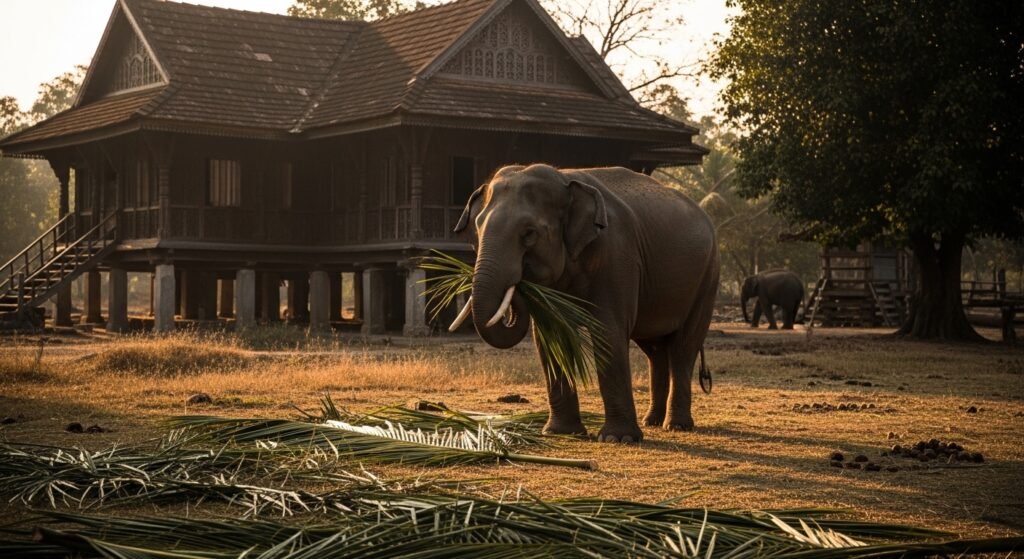
Ten kilometres north of Alleppey town, down a narrow lane that offers no signage and no ticket booth, sits one of the more unusual stops on any Alleppey itinerary. A small number of captive elephants — most of them Kerala temple elephants between religious procession seasons — live here with their mahouts in the grounds of a century-old carved wooden bungalow in the village of Kattoor. It is informal, unhurried, and unlike anything with a proper entrance gate.
Whether it belongs on your itinerary is a genuinely open question. Here is everything you need to decide.
Key Insights
- The camp is in Kattoor, approximately 10 km north of Alleppey — around a 20-minute auto-rickshaw ride
- Entry fee is around ₹50 per person; elephant rides cost ₹700–800; a full ride, bathing, and photo session package runs up to ₹2,000
- Open daily, approximately 8 AM–5:30 PM; there is no website or official signage — calling ahead is strongly advised
- Activities include elephant rides, feeding, bathing, camel rides, and fish foot massage
- Google rating: 3.7 out of 5 from 452 reviews — visitor experiences are genuinely divided
Where Is the Alleppey Elephant Camp?
The camp is located in Kattoor village, roughly 10 km north of Alleppey (Alappuzha) town, near the northern end of Punnamada Lake. On Google Maps it appears under both “Elephant Training Camp” and “Elephant Safari Alleppey” — these refer to the same place. The Google Plus Code is H878+RJM, Alappuzha, Kerala 688522, which will get you there accurately on any maps app.
The physical setting is striking in a way that no travel listing captures. The mahouts live and work in a wooden bungalow that is over 100 years old, with carved woodwork and a wide, open porch — it looks nothing like a tourist facility. The elephants are kept in the open grounds beside a bathing pond, and the surrounding area is green village farmland, well removed from Alleppey’s backwater tourism circuit.
There is no official name, no entrance gate, and no signs on the road. You will need to know where you are going.
How to Get to the Elephant Camp from Alleppey
An auto-rickshaw from anywhere in Alleppey town is the straightforward option. The fare is typically ₹200–300 depending on your starting point, and the journey takes around 20 minutes heading north on NH66 in the direction of Marari Beach. Ask to be taken to the elephant camp near Vellappalli Church, Canal Ward — this is the local reference point that auto drivers recognise.
Two phone numbers have appeared in visitor reports over the years: +91 9249905525 and +91 9895039767. Neither is officially published, and neither has been recently verified, so treat them as starting points and confirm before you travel. Asking your guesthouse or houseboat operator to make the call on your behalf is the most reliable approach — the mahouts speak Malayalam only, so a local intermediary makes communication considerably easier.
There are no confirmed seasonal closures, but as an entirely informal operation, the camp’s availability can vary. Calling ahead removes the risk of an unnecessary trip.
What to Expect at the Alleppey Elephant Camp
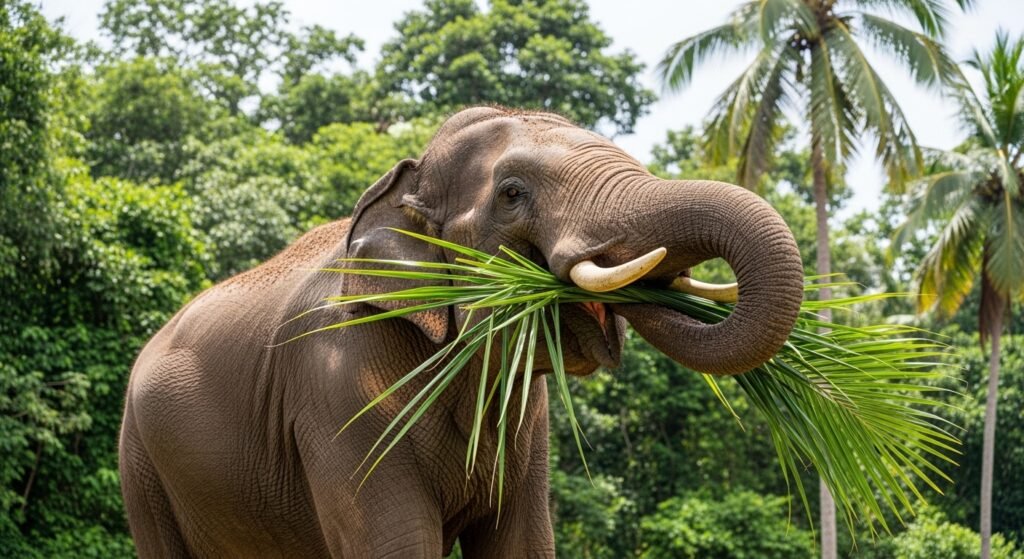
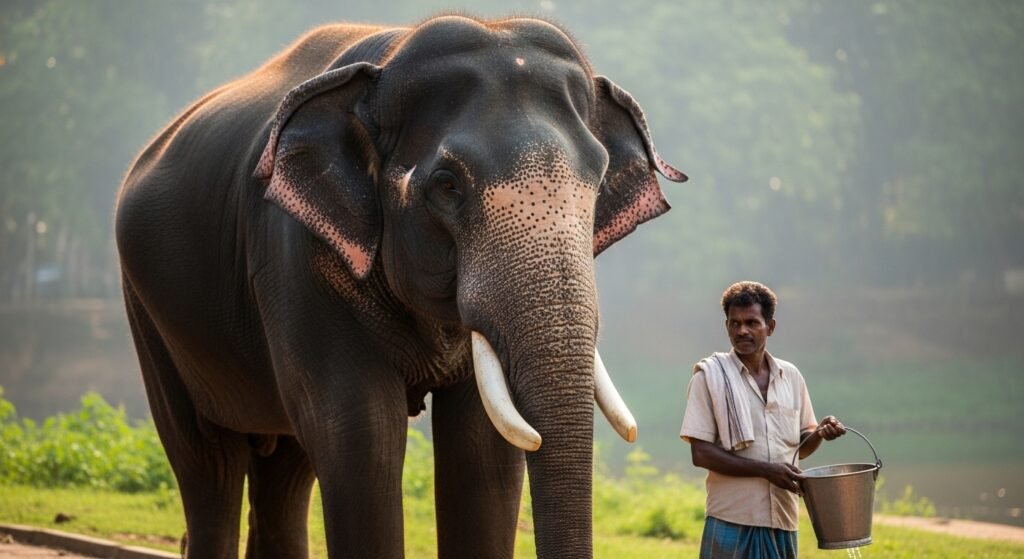
This is not a zoo, a sanctuary, or a conservation centre. The clearest way to understand what the elephant camp actually is: a small group of privately-owned captive elephants — most of them Kerala temple elephants — living with their mahouts during the months between festival engagements. Kerala’s temple elephant circuit runs across hundreds of festivals annually, and this is where the animals rest in between.
The elephants are looked after according to the traditional mahout care system. Mahouts bathe and massage their animals daily using coconut fibre and soft granite stones, and during the monsoon season, elephants typically receive Ayurvedic herbal treatments — decoctions made from medicinal plants — as part of their seasonal health routine. This is a practice specific to Kerala’s captive elephant culture, and it reflects the genuine bond that tends to develop between mahouts and their animals over years or decades of shared daily life.
Alongside the elephants, the camp also has exotic birds and reptiles, which some visitors find an unexpected addition. A typical visit runs to around 1.5 hours if you take in the main activities.
Activities and Pricing at the Elephant Camp
The camp offers elephant rides, feeding sessions, and bathing as its core experiences, with several add-on activities available. Pricing is set at the camp on the day — there is no advance booking system and no published price list.
| Activity | Approximate Price |
|---|---|
| Entry fee | ₹50 per person |
| Elephant ride (short) | ₹700–800 per person |
| Elephant feeding (group) | ₹500 |
| Ride + bathing + photo session | ~₹2,000 per person |
| Camel ride | ₹300–350 per person |
| Fish foot massage | ₹150 per person |
| Bird feeding | ₹100 per person |
Prices are based on visitor-reported data and may have changed. Confirm on arrival.
Morning is the best time to visit — it is cooler, elephant bathing sessions typically happen early, and the animals tend to be more active. The camp opens around 8 AM; arriving before 10 AM gives you the most time and the best conditions. The camp closes around 5:30 PM daily.
Is the Alleppey Elephant Camp Worth Visiting? An Honest Verdict
Visitor reviews from 452 Google ratings produce a score of 3.7 out of 5 — which looks moderate until you see the distribution. There are more five-star reviews (212) than any other rating, but the one-star count (76) is equal to the four-star count. This is a polarised experience, and the reason is consistent across negative reviews: short ride durations relative to the price, with some visitors reporting rides of five to ten minutes for ₹800.
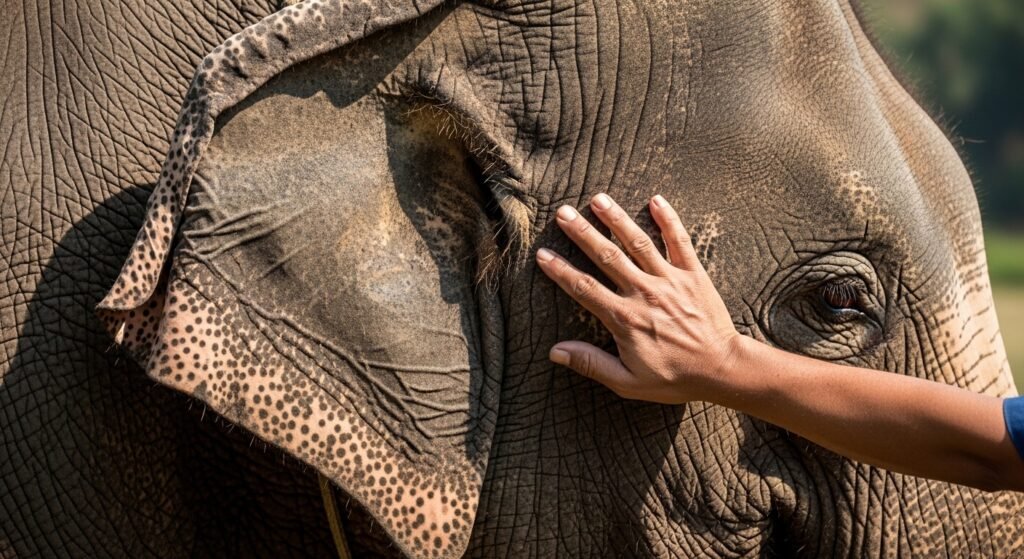
What visitors who rate it highly describe is the closeness. The opportunity to feed an elephant by hand, watch a mahout bathe one in the pond, or observe the quiet rhythm of a working mahout and his animal — these are genuinely uncommon interactions, and the informal setting makes them feel less staged than equivalent experiences at larger, more commercial facilities.
What the dissatisfied visitors describe is equally honest: this is a commercial operation where prices are set informally, durations are short, and there is no interpretive or educational component.
For those who want a more immersive or explicitly welfare-conscious elephant experience in Kerala, the Periyar Elephant Programme at Thekkady and the Kodanad Elephant Training Centre near Periyar offer more structured interactions and longer engagement times, though both require significantly more travel from Alleppey.
The Ethical Question: Should You Visit an Elephant Camp in Alleppey?
It is the question that surfaces in nearly every visitor review, and the one that no other guide honestly. Here is the context you need.
Kerala’s relationship with captive elephants is deep and contested. The state has the largest population of captive elephants in India — animals owned primarily by temples and private individuals, deployed in religious processions, and regarded culturally as sacred. The Alleppey elephant camp’s residents are part of this system: privately-owned temple elephants for whom tourist rides represent a revenue stream between festival seasons.
The welfare picture has attracted increasing scrutiny. Between 2018 and 2024, approximately 160 captive elephants died in Kerala — a figure that prompted the Kerala High Court in November 2024 to direct the state government to verify elephant ownership across the board, noting that a significant portion of current possession may be illegal under existing rules. The central government’s Captive Elephant (Transfer or Transport) Rules, 2024 added new regulatory requirements on captive elephant management.
Within Alappuzha district specifically, a shift is already visible. The Kanichukulangara Temple and the Cherthala Sree Mahadeva Temple have discontinued the use of live elephants in their ceremonies, citing safety and compassion. In February 2026, the Neelamkulangara Sreenarayana Vilasam Mahavishnu Temple in Panavally and the Omkareshwaram Sreerama Subrahmanya Temple in Cherthala adopted robotic elephants for festival processions, as part of an initiative by the Voice for Asian Elephants Society.
The practical guidance, if you choose to visit: feeding and bathing experiences are widely considered preferable to elephant rides from a welfare standpoint. If your primary motivation is a close encounter with elephants in an authentic Kerala context, read the next section first.
How to See Elephants in Alleppey Without the Camp
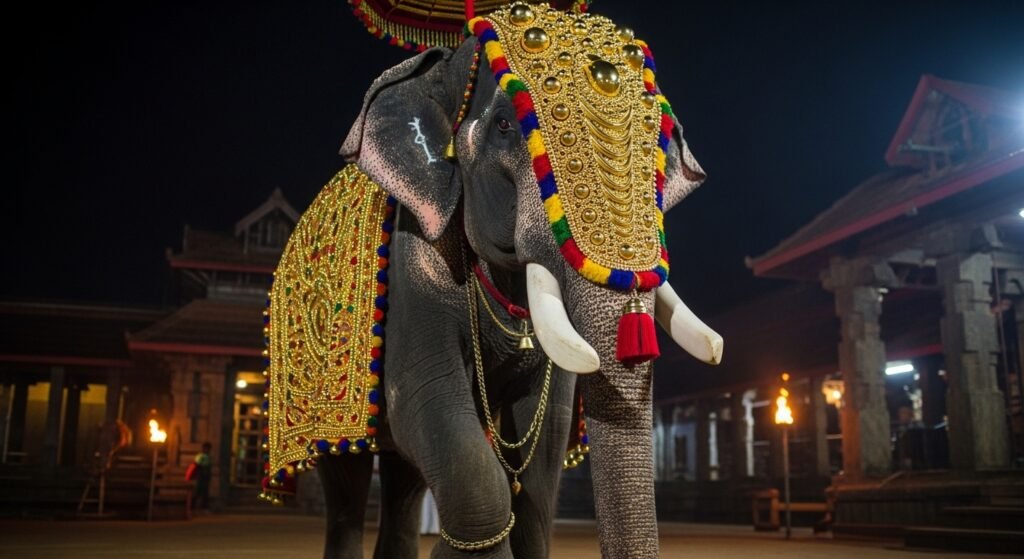
The most culturally authentic way to encounter elephants in Alleppey costs nothing and involves no commercial transaction. The Mullackal Chirappu Festival — a 41-day celebration held every December at the Mullackal Bhagavathy Temple in the heart of Alleppey town — features decorated temple elephants in genuine ritual procession as part of its programme. The elephants here are participating in the ceremonies they were trained for, in front of a largely local crowd. There is nothing touristic about it.
Onam, Kerala’s harvest festival celebrated in August or September, also features elephant processions in some Alappuzha district events, though the scale varies year to year.
For travellers who want an elephant encounter with a stronger conservation framework, the Periyar Elephant Programme at Thekkady (run by the Kerala Forest Department) is the most reputable option in the state, offering half-day and full-day interactions under trained naturalist supervision. It requires an overnight trip from Alleppey but represents a meaningfully different kind of experience.
FAQ — Alleppey Elephant Camp
Is there an elephant camp in Alleppey? Yes. There is a small, informal elephant camp in Kattoor, approximately 10 km north of Alleppey town near the northern end of Punnamada Lake. It operates without a website or signage and houses a small number of privately-owned captive temple elephants with their mahouts. It appears on Google Maps as the Elephant Training Camp (Plus Code: H878+RJM, Alappuzha 688522).
How much does the Alleppey elephant camp cost? Entry is approximately ₹50 per person. An elephant ride costs around ₹700–800; a full ride, bathing, and photo session package runs up to ₹2,000. Additional activities include camel rides (₹300–350), fish foot massage (₹150), and bird feeding (₹100). Prices are set at the camp on the day — there is no advance booking system, and these figures are visitor-reported rather than officially published.
How do I get to the elephant camp from Alleppey? An auto-rickshaw from Alleppey town is the practical option. The fare is typically ₹200–300 depending on your starting point, and the journey takes around 20 minutes. Head north along NH66 in the direction of Marari Beach and ask for the elephant camp near Vellappalli Church, Canal Ward. It helps to have your guesthouse or houseboat operator arrange transport or make the call ahead — the mahouts speak Malayalam only.
What is the best time to visit the elephant camp in Alleppey? Morning, ideally before 10 AM. The camp opens around 8 AM, it is cooler in the early hours, and elephant bathing sessions typically happen in the morning. The camp operates daily until approximately 5:30 PM. Because it runs as an informal operation, calling ahead to confirm availability before making the trip is always a good idea.
Is it ethical to visit the elephant camp in Alleppey? The honest answer is nuanced. The camp is a privately-operated tourist facility, not a sanctuary. If you visit, feeding and bathing experiences are preferable to elephant rides from a welfare standpoint. If ethics is your main consideration, the Mullackal Chirappu Festival in December (Mullackal Bhagavathy Temple, Alleppey town) offers free access to temple elephants in an authentic ritual context — without the commercial framework.
Are there elephants in Alleppey beyond the camp? Yes. The Mullackal Chirappu Festival in December features decorated temple elephants in procession at Mullackal Bhagavathy Temple in central Alleppey — the most authentic way to encounter elephants in the district. Some Alappuzha area temples also feature elephants during Onam celebrations. It is worth noting that several local temples, including Kanichukulangara Temple and Cherthala Sree Mahadeva Temple, have now discontinued the use of live elephants and switched to robotic alternatives.