
Before a single oar breaks the surface of Punnamada Lake, you can hear it. The chenda drums building from the far bank. A hundred voices rising in vanchipattu — the ancient boat songs of Kuttanad — carrying across the water in perfect rhythm. Then the starting signal fires, 150 oarsmen hit the water simultaneously, and the Chundan Vallam — a 100-foot snake boat with its prow rearing against the sky — lurches forward with a force that sends a wave rolling toward the bund where thousands of Alappuzha residents are screaming themselves hoarse.
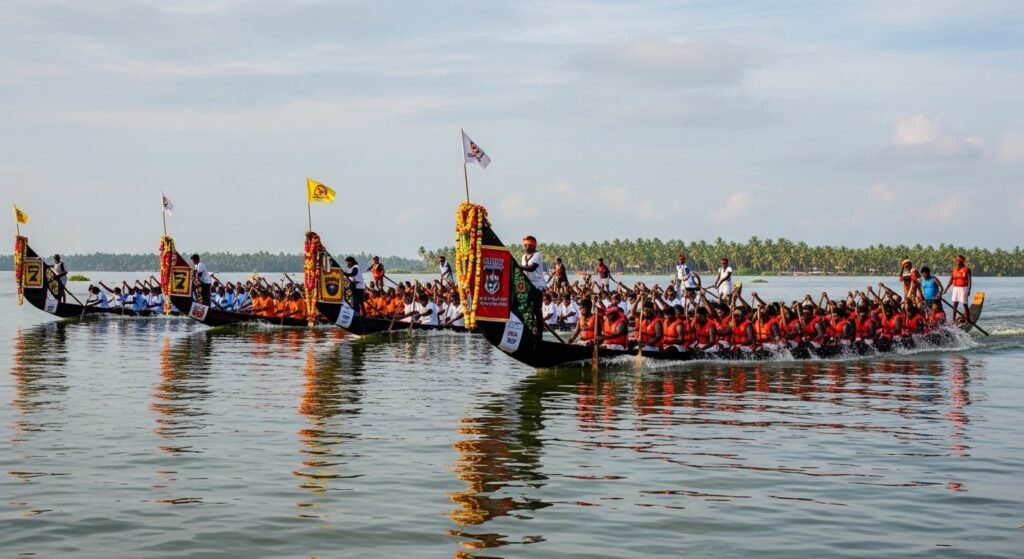
This is the Nehru Trophy Boat Race. And there is nothing else in India quite like it.
Key Insights
- Held every year on the second Saturday of August at Punnamada Lake, Alappuzha (Alleppey)
- The centrepiece is the Chundan Vallam (snake boat): 100–120 feet long, 100–150 oarsmen, 25 vanchipattu singers, 1 helmsman
- Ticket categories range from free bund viewing to mid-lake pavilion seats — each gives a completely different experience
- Heats begin around 11 AM; the Chundan Vallam grand final typically runs between 3:30–4:30 PM
- Trial runs take place one week before race day at 4 PM — a quieter, free way to see the full boats up close
What Is the Nehru Trophy Boat Race?
The Nehru Trophy Boat Race is an annual vallam kali — a traditional boat race festival — held on Punnamada Lake (Punnamada Kayal) in Alappuzha, Kerala, on the second Saturday of August. It is India’s most celebrated traditional water race and one of the largest sporting spectacles in South Asia, drawing close to 200,000 spectators each year.
The race involves 75 or more boats across nine categories, competing across four parallel 1,370-metre lanes. The centrepiece is the Chundan Vallam final — the snake boat race — but heats, quarter-finals, and semi-finals fill the full day from 11 AM to late afternoon.
Unlike most of Kerala’s other famous boat races — the Aranmula Boat Race (religious, tied to Onam) or the Champakulam Moolam Boat Race (the oldest vallam kali) — the Nehru Trophy has a secular, political origin, which makes it unusual in the tradition. It is also the most competitive: boat clubs train year-round, boats represent entire village communities, and the trophy carries a weight of pride that goes far beyond sport.
The History of the Nehru Trophy Boat Race
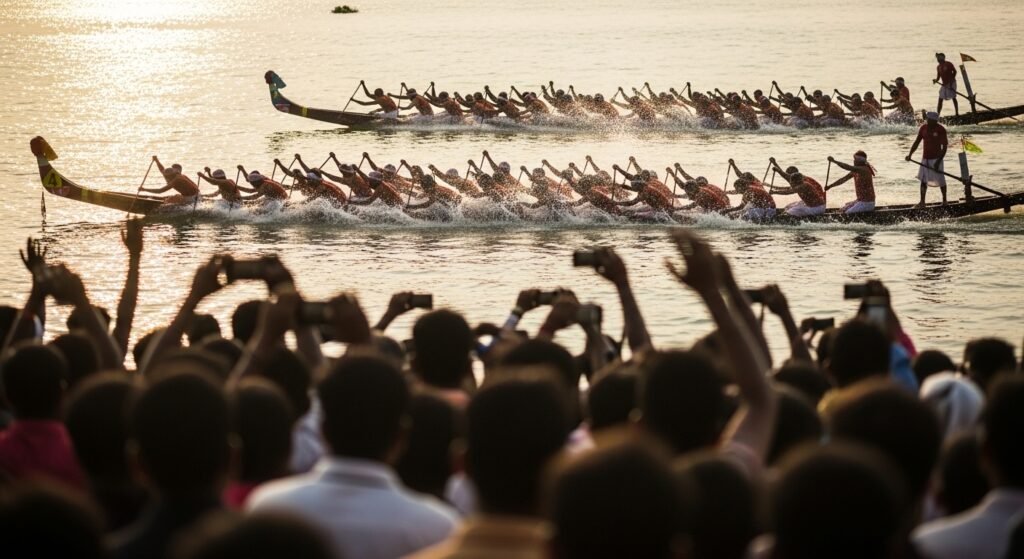
How It All Started: December 22, 1952
The origin of the Nehru Trophy is a single, unrepeatable moment.
Prime Minister Jawaharlal Nehru arrived at Munroe Thuruthu by boat from Kochi on December 22, 1952, travelling to Alappuzha. The people of Kuttanad — whose lives had always moved to the rhythm of the backwaters — received him the only way they knew how: with a procession of snake boats cutting across Vembanadu Lake. Nine boats competed. The crowd was enormous. The race reached its climax, and Nadubhagam Chundan won.
What happened next is the reason this race still draws hundreds of thousands of people seven decades later. Nehru, overcome with joy, forgot his security arrangements entirely and stepped into the winning boat. He was taken to Alappuzha aboard Nadubhagam Chundan — a Prime Minister arriving into town on the back of a snake boat race victory — and the crowd went wild.
Back in Delhi, Nehru ordered a silver trophy to be made: a replica of a Chundan Vallam mounted on a wooden abacus, bearing his autograph and the inscription: “To the winners of Vallamkali, the symbol of the social life of Thiru-Kochi.” It was originally called the Prime Minister’s Trophy. After Nehru’s death, it was renamed the Nehru Trophy — and the race has carried that name ever since.
From Vembanadu to Punnamada
The first race took place at the western end of Vembanadu Lake. In 1955, the event was moved to Punnamada Kayal — a broader, more manageable stretch of water to the north of Alappuzha town — where it has been held ever since. The race track today spans four parallel lanes, each 1,370 metres long, with bamboo poles marking the course. The Nehru Pavilion at the finishing line was built in 2004; temporary galleries are constructed around it each year to accommodate the crowds.
The Boats: Chundan Vallam and the Nine Race Categories
The Star: Chundan Vallam (Snake Boat)
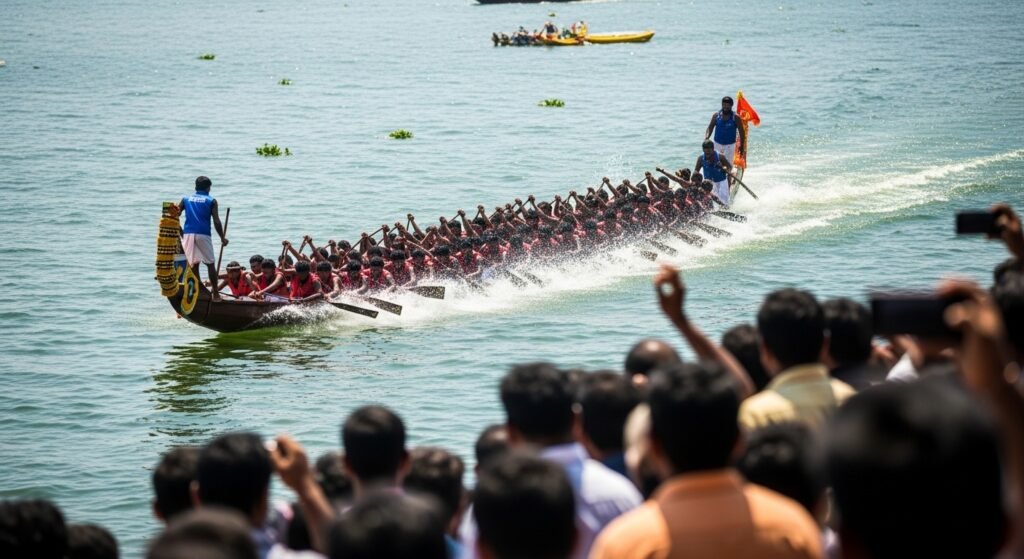
Nothing prepares you for the size of a Chundan Vallam in motion.
These are not racing boats in any modern sense. They are traditional war vessels — the kind that once carried warriors across the backwaters of Kuttanad — repurposed for competition and decorated with brass fixtures and silk umbrellas. Each one is 100 to 120 feet long, hand-carved from anjili wood (a species of Artocarpus native to Kerala) by specialist craftsmen, with a hull so low it sits almost level with the water and a prow that rears 20 feet into the air like a serpent about to strike.
The crew of a competing Chundan Vallam numbers 125 to 150 people. Of these, around 100 to 125 are oarsmen, rowing in strict synchrony to the beat of chenda drums. Twenty-five are vanchipattu singers — their role is not decoration but function, providing the rhythmic call that keeps every oar in time. Standing at the very tip of the raised prow, visible above everything else, is the thalappan: the helmsman, whose job is to steer and to embody the spirit of the boat.
When a Chundan Vallam is at full speed, the hull barely breaks the surface. The sound — drums, voices, churning water, crowd — is overwhelming in the best possible way.
The Other Boat Categories
Eight further categories compete alongside the Chundan Vallam:
Churulan Vallam — a traditional passenger boat whose bow and stern curve into a tight coil (churul means coil in Malayalam). Around 45 crew members compete in these.
Iruttukuthy Vallam — historically designed for night travel across the backwaters; a streamlined, fast hull.
Odi Vallam — a lightweight transport boat built for speed; one of the more accessible categories for smaller competing clubs.
Veppu Vallam (Vaipu Vallam) — a medium-sized passenger vessel; around 40–45 crew.
Vadakkanody Vallam — a northern-style boat with a distinct hull profile, originating from the northern Kuttanad villages.
Kochu Vallam — small boats; the category that brings in a wider field of competing teams.
Churulan Vallam (Ladies) and additional mixed categories have been introduced in recent editions, reflecting the race’s evolution since international and female participation began in 2006.
The Race Format: How a Full Day at the Nehru Trophy Works
The Nehru Trophy is not a single race — it is a full-day regatta with a knockout structure.
Heats begin at approximately 11 AM. Each boat category runs its own heats, with the top finishers advancing through quarter-finals and semi-finals. The Chundan Vallam rounds are spread across the day and culminate in the grand final, which typically takes place between 3:30 PM and 4:30 PM — the emotional centrepiece that the entire day has been building toward.
At the start of each heat, boats line up across the lake in their assigned lanes. The drumbeat signals readiness; when the starting signal fires, all crews enter the water together. A competitive Chundan Vallam heat over 1,370 metres takes roughly four to five minutes. The difference between winning and losing at the elite level is often a matter of two or three seconds — which, given that 125 people are rowing in perfect synchrony, tells you something about the precision involved.
Arrive at the venue by 10 AM. The atmosphere during the early heats is relaxed and festive; by the time the Chundan Vallam semi-finals begin in the early afternoon, the crowd noise has built to something that rattles your chest.
Champions, Records, and Legends
Every Chundan Vallam represents a village — a community that has likely been building, training, and competing together for generations. The boats that have accumulated the most trophies carry a weight of legend that genuine fans of the race understand immediately.
Karichal Chundan is the most decorated boat in Nehru Trophy history, holding the record for the greatest number of wins — including two hat-tricks and five consecutive victories between 1980 and 1984.
Nadubhagam Chundan — the boat that carried Nehru into Alappuzha in 1952 — holds the Guinness World Record for the world’s longest rowing boat.
Napoleon Chundan achieved the first hat-trick in Nehru Trophy history, winning consecutively from 1957 to 1959.
Pallathuruthy Boat Club is the dominant contemporary force, having won five consecutive Nehru Trophies through 2024 — a modern dynasty that has brought the pressure of history onto younger clubs trying to end the streak.
VBC Kainakari (Veeyapuram) won the 71st edition in 2025, ending Pallathuruthy’s run.
Where to Watch: A Guide to Every Viewing Option
The experience of the Nehru Trophy changes completely depending on where you watch from. Here is an honest breakdown of each option.
Island Nehru Pavilion (Best for Tourists)
The Nehru Pavilion is a permanent structure built mid-lake at the finishing line. It gives you the closest, clearest view of the Chundan Vallam crossing the finish — boats arriving at full speed directly in front of you. This is where Tourist Gold and Tourist Silver tickets place you.
Access is by ferry from the DTPC Jetty near the District Tourism Promotion Council office in Alappuzha town. Even if you booked online, you must collect a physical ticket from the DTPC counter (near the KSRTC bus stand) from 8 AM on race day. The ferry stops running after 10 AM — if you miss it, you cannot enter the pavilion. Once inside, you stay until the race ends; there is no exit mid-event.
Rose Corner
A covered gallery positioned near the finishing line, with excellent sightlines of the final stretch. Entry is from the Alleppey Finishing Point (separate from the DTPC Jetty). Good option if the Island Pavilion categories are sold out — you lose the mid-lake perspective but gain easier access logistics.
Victoria Line
A covered pavilion stretching along the far end of the course near the Ramada Hotel. Broader views of the racing lane rather than the finish line close-up. Good for families with children and for anyone who wants to watch the full race unfold rather than focus on the finish.
Open Gallery / All View
The budget option: no covered seating, no shelter from sun or monsoon rain. In exchange, you get the most raw, high-energy festival atmosphere of any ticketed gallery — standing room, full crowd noise, the kind of experience you’d find difficult to replicate. Bring sun protection and a waterproof layer regardless of the forecast.
Free Bund Viewing (The Local Option)
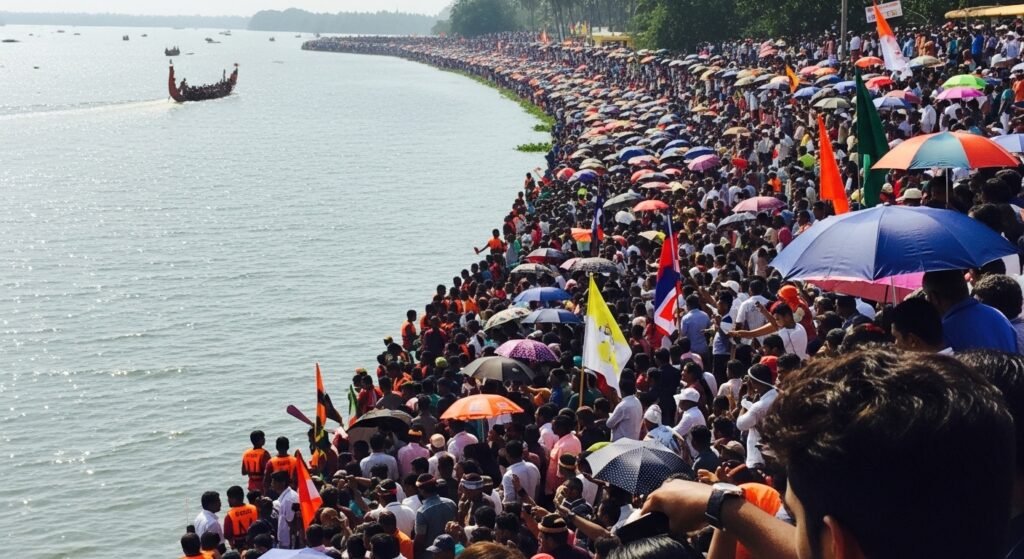
The earthen bund running along the race route is where most Alappuzha residents actually watch the Nehru Trophy. There are no tickets, no booking required, and no entry process. You stand at the water’s edge as the boats pass at full speed — close enough to feel the displaced air.
The sightlines are not as controlled as a pavilion, and you may find yourself watching through gaps between people, but the atmosphere is genuine in a way that ticketed galleries are not. If you want to watch the race the way Kuttanad people watch it, this is the place to be.
Watching from a Houseboat
For groups of 20 or more, a private houseboat anchored on Punnamada Lake is arguably the finest way to experience the race. Upper-deck viewing with unobstructed sightlines across the racing lanes, your own food and drinks, no crowds. The boat stays in position for the full day.
The caveat: houseboats on race day are the first accommodation to sell out, often three to four months in advance. If this is your preference, lock it down before you book anything else — including flights.
Tickets: Categories, Prices, and How to Book
Ticket categories for the Nehru Trophy are tiered to match each viewing area. From the top: Platinum Corner (a luxury box with food included and a dedicated boat transfer), Tourist Gold and Silver (Island Nehru Pavilion), Rose Corner, Victoria Line, and Open Gallery. Prices change each year, so check the official website — nehrutrophy.nic.in — for current rates. Booking typically opens in late July; some categories sell out within days of going live.
A few practical notes: the maximum per booking is 5 tickets. Payment is accepted through SBI, Federal Bank, and KVB payment gateways online. There are also offline counters at DTPC Alappuzha for in-person purchase.
How to Reach Alappuzha
By air: Cochin International Airport (Kochi) is the nearest airport, approximately 85 km from Alappuzha — around two hours by road. Taxis and KSRTC buses run the route regularly.
By train: Alappuzha Railway Station is well-connected to Kochi, Thiruvananthapuram, Chennai, and Mumbai. It sits about 3 km from Punnamada Lake; auto-rickshaws and local ferries cover the distance easily.
By road: NH 544 connects Alappuzha to Kochi (approximately 84 km). On race day, roads near the venue are closed to private vehicles. Park at the Municipal Stadium (north of Zillah Court Bridge) — the designated parking area — and take an auto-rickshaw or local ferry from there to the jetty.
When to Visit: Timing, Trial Runs, and Race Day Planning
The race is held on the second Saturday of August every year. The day runs from approximately 11 AM (first heats) to 4:30 PM (after the Chundan Vallam final). August is deep monsoon in Kerala — the weather is hot, humid, and unpredictable. Pack light, bring a compact rain layer, and carry sun protection regardless of whether it looks overcast at 9 AM.
The trial runs are the insider secret nobody tells you about. One week before race day, the competing Chundan Vallams do full practice runs on Punnamada Lake at 4 PM each afternoon. There are no tickets, no crowds, and no entry barriers. You can stand on the bund and watch the full snake boats move at competition pace, close enough to hear the vanchipattu clearly above the chenda drums. For anyone with even a passing interest in the boats themselves — their construction, their sound, the choreography of 125 people rowing as one — the trial runs are worth planning your trip around. Confirm the exact dates with DTPC Alappuzha from July onwards.
Recommended stay: two nights minimum. Arrive the afternoon before race day (houseboats and town accommodation are packed from the day before), attend the full race, and leave the following morning. Alleppey’s backwaters, beaches, and canal markets are worth the extra day if you can manage it.
What Race Day in Alleppey Actually Feels Like
By 9 AM on race day, Punnamada Lake is already transformed. Temporary galleries line the bund. Food stalls are setting up — banana chips, pazham pori (banana fritters), fresh tender coconut, Kerala-style snacks in newspaper cones. Families from across Kuttanad are already in position, wearing the colours of their village’s boat.
The Chundan Vallams begin assembling on the lake for the heats: these enormous wooden vessels moving with a strange, dreamlike grace when not at speed, their prows rising absurdly above the water. The oarsmen are warming up; the vanchipattu singers are rehearsing call-and-response phrases that have been sung on these boats for centuries. The chenda drummers are already audible from 500 metres away.
When the starting signal goes and a heat begins in earnest, the sound changes. The drumbeat accelerates, the singing locks into race tempo, and 125 oars enter the water in a single stroke that visibly lifts the hull. The crowd noise — 200,000 people, many of whom have been coming to this race since childhood — rises to something that makes individual voices inaudible. By the Chundan Vallam final, it is simply a wall of sound.
Since 2023, the Nehru Trophy has been run as a plastic-free festival under the Green Boat Race Initiative: single-use plastics are banned at the venue, solar lighting is used at the pavilion complex, and community cleanup drives take place before and after the event. The race’s relationship with Punnamada Lake is, in that sense, being taken seriously in a way it wasn’t a decade ago.
FAQ
When is the Nehru Trophy Boat Race held? Every year on the second Saturday of August. The venue is Punnamada Lake (Punnamada Kayal), Alappuzha. The 71st edition was held on August 30, 2025; the next race follows the same scheduling pattern.
Where exactly does the race take place? On Punnamada Lake, approximately 3 km from Alappuzha town centre. The race track runs across four parallel lanes, each 1,370 metres long, finishing at the Island Nehru Pavilion in the middle of the lake.
What is a Chundan Vallam? A Chundan Vallam is a traditional Kerala snake boat — a hand-carved wooden vessel measuring 100 to 120 feet long, built from anjili wood, with a dramatically raised prow. Each competing boat carries 100–125 oarsmen, 25 vanchipattu (boat song) singers, and one thalappan (helmsman) who stands at the prow throughout the race.
How do I get tickets and which category should I choose? Book through the official website at nehrutrophy.nic.in. Tickets go on sale in late July and sell out quickly. For the closest view of the finish, choose Tourist Gold or Silver (Island Nehru Pavilion). For easier access logistics, Rose Corner or Victoria Line are strong alternatives. If you want the local atmosphere without a ticket, the bund is free and electric. Prices change annually — check the official site for current rates.
Which boat has won the most Nehru Trophies? Karichal Chundan holds the record for the greatest number of Nehru Trophy wins, including two hat-tricks and five consecutive victories (1980–1984). Nadubhagam Chundan — winner of the first race in 1952 — holds the Guinness World Record for the world’s longest rowing boat. Pallathuruthy Boat Club is the current dominant force, having won five consecutive titles through 2024 before VBC Kainakari (Veeyapuram) won the 71st edition in 2025.
Can you watch the race from a houseboat? Yes, and it is one of the most memorable ways to experience it. Private houseboats anchored on Punnamada Lake offer upper-deck views directly over the racing lanes, with no crowds and your own food and refreshments. Book three to four months in advance — race-day houseboats sell out faster than tickets.
Is there a free way to watch? Yes. The earthen bund along the race route offers free viewing with no booking required. Sightlines are at water level rather than elevated, but you are right beside the boats as they pass. This is how most local Alappuzha residents watch the race.
What are the trial runs? Trial runs take place approximately one week before race day, each afternoon at around 4 PM on Punnamada Lake. They are free, open to the public, and involve the full competing Chundan Vallams running at race pace. The crowd is a fraction of race day — making them the best opportunity to see the boats close up and hear the vanchipattu clearly. Check with DTPC Alappuzha for confirmed dates from July each year.
The Nehru Trophy Boat Race is not just Alleppey’s biggest day — it is Kuttanad’s Olympics on water, a living tradition that connects the communities of Kerala’s backwaters to a moment in 1952 when a Prime Minister forgot his security detail and stepped into a winning boat. Plan carefully, arrive early, and let the vanchipattu do the rest.