
There’s a particular pleasure in sitting at a rough wooden table with a canal three feet away, palms casting afternoon shade, a clay vessel of milky-white kallu in front of you and a plate of karimeen pollichathu in the middle. It doesn’t feel like a tourist experience. It feels like you stumbled into someone’s Tuesday.
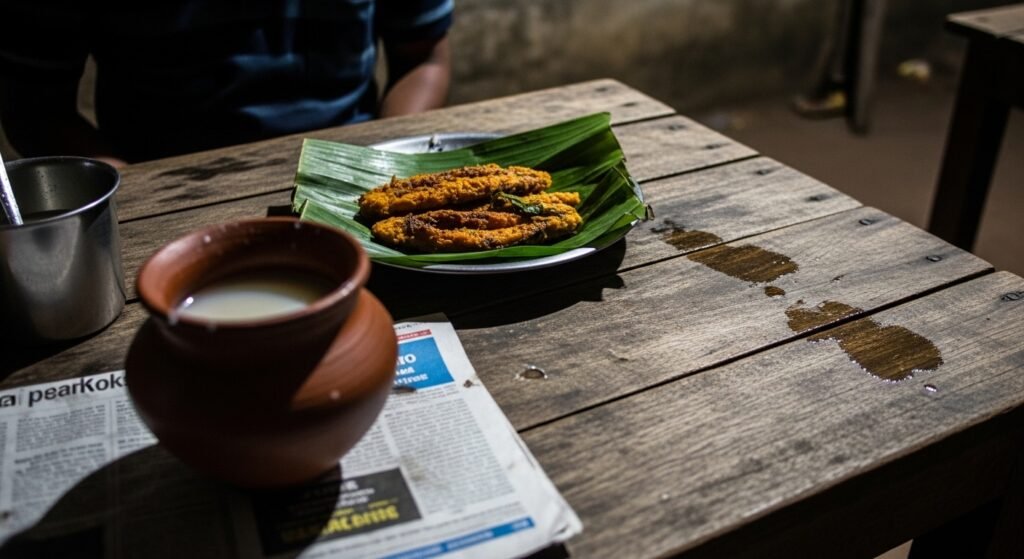
That’s toddy in Alleppey — and it’s one of the most genuinely local things you can do here.
Quick Answer
- Toddy (kallu) is fermented coconut palm sap — milky-white, slightly fizzy, mildly alcoholic when fresh
- Alleppey’s backwater kallu shaaps in Kuttanad are the most atmospheric in Kerala; many are reachable only by shikara or houseboat
- The essential pairing: fresh toddy with karimeen pollichathu or kappa meen curry
- Best shops: Aatumukham (Kainakary), Pakku’s (Pallathuruthy), Mini Kalpakavadi (Chembumpuram), Rajapuram (Kavalam), Subhash’s (Alleppey)
- Toddy is legal and licensed by the Kerala Excise Department; alcohol content ranges from 2–4% in the morning to 6–8% after two or three days of fermentation
What Is Toddy (Kallu)?
Toddy is fermented coconut palm sap — known locally as kallu, the Malayalam word that locals have used for this drink for centuries. It’s drawn from the flower of the coconut palm before it blossoms, collected in clay pots by a tapper who climbs the tree twice a day. The liquid is milky-white, faintly fizzy, and has a flavour that shifts dramatically depending on how long it’s been fermenting.
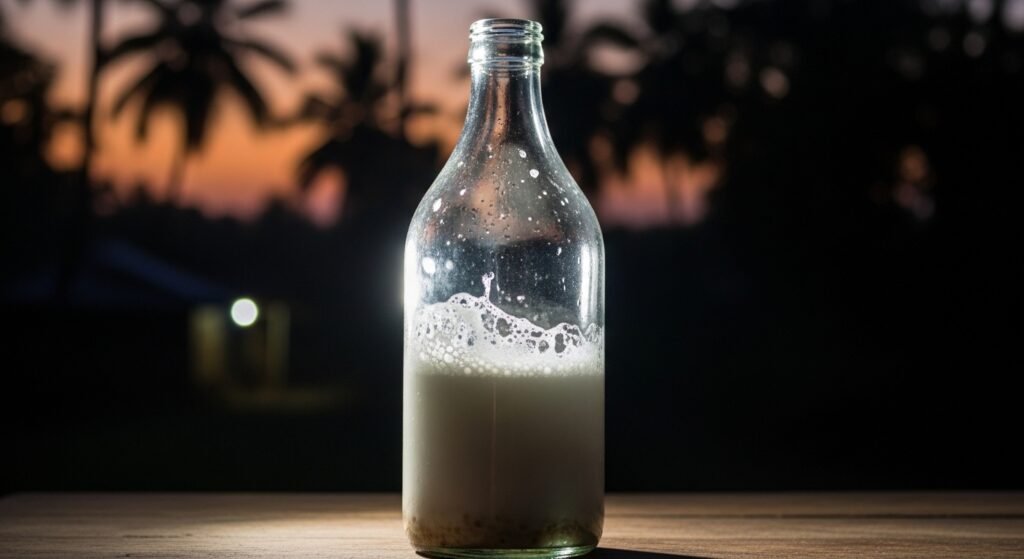
In its freshest state, kallu is closer to a sweet sparkling coconut drink than what most people expect from an alcoholic beverage. Left to ferment through the day, it grows stronger and sourer. By the second or third day, it becomes a full-bodied palm wine with a sharp, tangy edge. The version you’ll drink at an Alleppey kallu shaap is almost always same-day toddy — the shelf life is roughly 24 hours before it tips into vinegar.
Toddy is also distinct from neera, which is the unfermented sap collected at dawn before natural yeast in the air has begun working on it. Neera is sweet, non-alcoholic, and occasionally sold as a wellness drink — but it isn’t what toddy shops serve.
In Kerala, the toddy industry is formally licensed and regulated by the Kerala Excise Department, employing over 50,000 people across tapping, distribution, and retail. A glass of kallu from a licensed shop in Alleppey is not a grey-market transaction — it’s a deeply rooted part of the state’s food economy and cultural life.
Fresh Toddy vs. Fermented Toddy: What’s the Difference?
The time you visit a toddy shop determines what you drink.
| Time | Fermentation Stage | Approximate ABV | Taste Profile |
|---|---|---|---|
| Morning (before noon) | Minimal — just hours old | 2–4% | Sweet, slightly fizzy, coconut-forward, clean finish |
| Afternoon/Evening | Same-day fermentation | 4–6% | Stronger, sourer, more complex, slightly yeasty |
| Day 2–3 | Extended fermentation | Up to 8% | Tangy, heavier, sharp — closer to wine |
For first-timers, morning toddy is the right introduction. If you’re after the more assertive version that locals drink after a day’s work, come at 5 PM.
How Toddy Is Tapped in Alleppey
In the Kuttanad region around Alleppey, toddy tapping has been practised for generations by the Ezhava community, whose association with the coconut palm and its products is part of the cultural fabric of this part of Kerala.
A tapper climbs the same trees twice a day — at dawn and again at dusk — barefoot or with a rope loop around the ankles for grip, ascending trees that can reach 80 feet without any safety equipment. At the crown, they use an olakka (a curved tapping knife) to make a fresh cut in the flower stump, and a kochukathi (a smaller secondary blade) to clean the tap point. The cut seeps sap into a clay pot tied to the stump. That pot comes down the next climb, the sap poured into larger vessels and delivered to the kallu shaap before it’s been fermenting long enough to become undrinkable.
If you’re travelling through Kuttanad by shikara or houseboat in the early morning, watch the coconut palms. The figure moving steadily up the trunk before sunrise, barely visible against the grey sky, is doing a job that has looked exactly like this for hundreds of years.
What Alleppey’s Kallu Shaaps Are Really Like
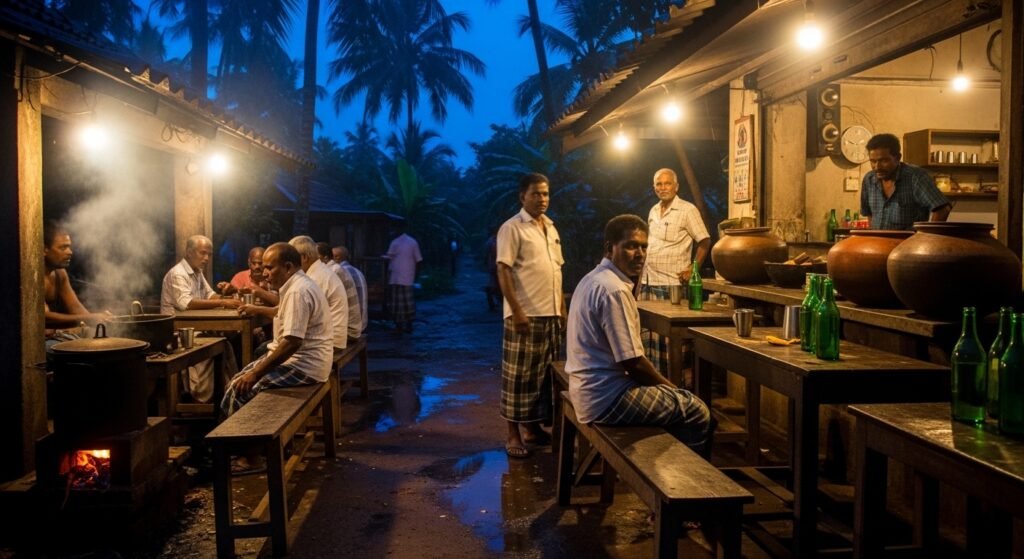
Alleppey’s kallu shaaps are not bars — they are working-class social institutions built around a canal view and a shared plate. The Kuttanad versions, in the backwater region that fans out south and east of Alappuzha town, are simpler and more specific than the sanitised “toddy bar” idea.
Most are open-sided structures: a few wooden tables, benches, a concrete floor, a view of a canal or paddy field. There’s no drinks menu. You ask for kallu and it arrives in a clay or glass vessel. The food comes to the centre of the table — shared dishes, always made to order, always fiercely spiced. The atmosphere is post-work and unhurried. Conversations run long. Card games are common. It’s a social institution, not a hospitality experience.
The Kuttanad shops differ from urban Kerala toddy shops in one important way: the setting does a lot of the work. The combination of a glass of fresh kallu, a backwater visible from your table, and a plate of fish that was caught nearby that morning is something no city shaap can replicate. Tourists who stumble into this world — usually by shikara or as part of a houseboat trip — often say it was the most authentically local moment of their visit to Alleppey.
One honest note: traditional kallu shaaps skew heavily male in clientele. This is a reflection of local social norms, not a hard rule. Several shops in the Alleppey area have evolved into family-format restaurants that welcome mixed groups and visitors of all backgrounds. More on this in the safety and logistics sections below.
The Best Toddy Shops in Alleppey
The five best toddy shops in and around Alleppey are Aatumukham (Kainakary), Pakku’s (Pallathuruthy), Mini Kalpakavadi (Chembumpuram), Rajapuram (Kavalam), and Subhash’s — each with a distinct setting and character. Here’s what you need to know about each one.
Aatumukham Restaurant & Toddy Shop — Kainakary
Located at Pallathuruthy, Kainakary South, Aatumukham is probably the best-known backwater toddy shop in the Alleppey area — and for good reason. It’s one of the only Kuttanad shops accessible by both road and water, which makes it a natural stop for houseboat travellers and shikara trips alike. The menu goes well beyond the standard shaap offering: thala curry (fish head curry), njandu (crab), duck, prawn, and chicken are all regulars. Dining happens in private hut-style rooms or on the water itself. Expect crowds at peak season; the food quality is consistently high, though a few reviews flag pricing on the higher end for a toddy shop.
Pakku’s Toddy Shop — Pallathuruthy
In the Pazhaveedu area near Kainakary, Pakku’s is a more stripped-back, canal-facing kallu shaap that draws a local clientele as much as tourists. The toddy is fresh and the seafood menu is exactly what you want — simple, well-sourced, aggressively spiced. It’s the kind of place that doesn’t market itself because it doesn’t need to. Part of the authentic Kuttanad village experience.
Mini Kalpakavadi — Chembumpuram, Kuttanad
Deeper into the backwaters, toward Nedumudi and Champakulam, Mini Kalpakavadi sits in the kind of setting that makes Kuttanad toddy culture different from anywhere else in Kerala. It’s on the houseboat and shikara route through central Kuttanad, which means it’s often a natural lunch or early evening stop. Solid kallu and a well-rounded Kerala non-veg menu.
Rajapuram Family Restaurant & Toddy Parlour — Kavalam
Kavalam village, southwest of the main Kuttanad canal network, is home to Rajapuram — a family restaurant format that explicitly welcomes mixed groups. If you’re visiting with a partner, friends, or are a solo female traveller who prefers a less male-dominated environment, Rajapuram is the most comfortable of the Alleppey area options. The toddy quality is good and the food menu covers all the Kuttanad staples.
Subhash’s Toddy Shop — Alleppey
Subhash’s (also known as Subhash Hotel) is a local’s favourite more than a traveller’s destination — a rural Alleppey spot that serves some of the best Malayali food in the area at prices that haven’t caught up with tourism. No atmosphere manufactured for outsiders; just honest kallu and food that locals return to. The kind of place worth seeking out if you want the unperformed version of this experience.
What to Eat at an Alleppey Toddy Shop
Shaap food is designed around toddy. The spicing is deliberate — bold chilli heat, sour tamarind, coconut oil — because the sweetness and low ABV of fresh kallu needs something punchy to balance it. This isn’t food that works without the drink.
Karimeen pollichathu is the first thing to order. Karimeen (pearl spot fish, Etroplus suratensis) is native to Kerala’s backwaters, and the pollichathu preparation — marinated in red masala, wrapped in banana leaf, pan-roasted — is the signature pairing with toddy in Alleppey. The fish is often caught within a few kilometres of where you’re sitting.
Kappa meen curry is the essential comfort combination. Kappa (boiled, lightly mashed tapioca) with a spiced fish curry built on tamarind, coconut, and chilli is the toddy-shop classic across Kerala, and in Kuttanad the fish curry is often made with the same karimeen or with a small river fish.
Duck mappas is the Kuttanad-specific order. This isn’t the generic duck roast you find across Kerala — duck mappas is slow-cooked in coconut milk with whole spices, a richer, slightly sweet preparation that works specifically well against a soured afternoon toddy. Duck farming is a significant part of Kuttanad’s local economy, so the bird on your table is genuinely local.
Beef fry with coconut and curry leaves, and njandu (crab) curry round out the usual order for a table sharing a few glasses. Both are consistent across Alleppey-area shaaps and both hold up well against the stronger, fermented toddy served later in the day.
One more cultural footnote worth knowing: kallappam — the rice pancake leavened with toddy instead of yeast — is a traditional Kuttanad breakfast that shows toddy’s role extends beyond drinking. Some shops serve it with fish curry or beef roast, and it’s worth trying as a morning starter before the kallu itself.
How to Reach an Alleppey Toddy Shop
Most Kuttanad toddy shops are not walkable from Alleppey town — you need a boat, a ferry, or a car to reach them. Here are the four practical options, from cheapest to most curated.
By shikara from Alleppey jetty is the most direct independent option. Hire a shikara from the main Alappuzha boat jetty and ask to go to Kainakary — the journey takes roughly 1.5–2 hours each way through the canals, passing paddy fields, Chinese fishing nets, and village life. Aatumukham and Pakku’s are both accessible on this route. Budget for a half-day on the water.
By houseboat is how most visitors encounter a backwater toddy shop. Overnight houseboat routes through Kuttanad naturally pass the Kainakary area. Ask your houseboat operator in advance to schedule a stop at a kallu shaap — it’s a common request and most operators know the spots. Aatumukham is the standard stop because of its water access.
By government ferry is the budget option that almost no travel guide mentions. The “See Kuttanad” government ferry departs from Alappuzha boat jetty and passes through the Kuttanad backwaters toward Changanacherry, passing near Kainakary. The fare is almost nothing. The journey takes longer than a private shikara but passes through the same landscape. Ask locally about current departure times at the jetty.
By road is only viable for Aatumukham (Kainakary South) and Rajapuram (Kavalam) among the shops listed here. Both have road access alongside their water access. From Alleppey town, Kainakary is roughly 20 km — about 40 minutes by auto-rickshaw or car via Cherthala Road.
Nadodi Kayaking’s Golden Tour is worth mentioning for travellers who want a structured experience rather than a self-guided one. This tour combines kayaking through the Kuttanad backwaters with a local fishing stop and an authentic toddy tasting at a kallu shaap — the most curated way to arrive at a backwater shop with context, a guide, and an itinerary that makes sense of what you’re seeing around you.
Toddy vs. Beer: Why Locals Choose Kallu
Locals choose kallu over cold beer at a shaap for reasons that are simultaneously about taste, culture, food pairing, price, and geography — and every one of those reasons holds up.
The taste case is real. Fresh morning kallu has a complexity that beer doesn’t approach — it’s faintly fizzy, coconut-forward, faintly sweet, and finishes clean. It tastes like the place it came from. Beer, by contrast, is a commodity; a Kingfisher in Alleppey tastes exactly like a Kingfisher anywhere else.
The food case is perhaps more important. Toddy’s mild sweetness and low alcohol in fresh form was made for shaap food — the extreme spice, the tamarind, the chilli. Beer’s bitterness competes with these flavours; spirits overwhelm them. Kallu complements. This isn’t a cultural argument — it’s a culinary one that locals have field-tested for generations.
The cultural case matters too. Kallu is what people in Kuttanad have drunk with their meals for longer than anyone can trace. Beer arrived later. At a backwater toddy shop, ordering a cold beer instead of kallu is a bit like ordering a sandwich at a Punjabi dhaba — technically possible, fundamentally wrong.
The price case is straightforward: toddy costs a fraction of bottled beer, particularly in backwater shops where the beer has to be shipped in and the toddy was tapped that morning three kilometres away.
And the experience case is the one that sticks. You can drink beer in any city in the world. You can drink fresh coconut palm wine tapped this morning from a Kuttanad backwater — with crab curry and a canal view — only here.
Is Toddy Safe to Drink in Alleppey?
Toddy from a licensed kallu shaap in Alleppey is safe to drink. The Kerala Excise Department licenses toddy retailers, and established shops like those listed above serve genuine same-day coconut toddy. You are not buying an unregulated substance.
The “water mixing” concern repeated on some travel blogs applies to unlicensed street vendors, not functioning licensed shops. At a proper kallu shaap, what’s in your glass is fermented coconut palm sap — no more, no less.
The practical points: toddy has a short shelf life (around 24 hours), so there’s no incentive for a shop to serve stale product. Fresh morning toddy at 2–4% ABV is the gentlest starting point; moderate your intake with afternoon or evening toddy, which sits at 4–6% and can go higher. Drink with food — which is the local custom anyway.
For female travellers: the most comfortable options in the Alleppey area are Aatumukham (Kainakary) and Rajapuram (Kavalam), both family-format establishments that regularly host mixed groups and tourists. A guided visit — via Nadodi Kayaking’s Golden Tour or a shikara trip with a local guide — is the easiest way to experience a backwater kallu shaap comfortably if you’re travelling solo or are unfamiliar with the area.
When Is the Best Time to Visit Alleppey Toddy Shops?
Time of day makes a significant difference to what you drink. Morning visits (before noon) give you the freshest, sweetest toddy — tapped at dawn, barely fermented, closer to a coconut drink than wine. If that’s what you’re after, aim to arrive at a shop between 11 AM and 1 PM when the morning tap has just come in. Evening visits, roughly 5 PM to 8 PM, offer the post-work atmosphere — the shop filling up, dishes coming out to shared tables, the toddy tangier and stronger from a full day’s fermentation. Both are worth experiencing; they’re different drinks and different moods.
Time of year affects both the quality and the atmosphere. October through March is peak season in Alleppey and the best window for a backwater toddy experience: the weather is dry, the canals are navigable, and the shops are at their most active. The Nehru Trophy Boat Race, held in August on Punnamada Lake, brings a concentrated burst of energy to the whole Alleppey area — toddy shops see high footfall during this period.
The monsoon months (June through September) are not a write-off. Kuttanad during the monsoon is a different landscape — dramatic flooding in the paddy fields, reduced tourist traffic, a more local feel. Most shops continue to operate, though houseboat and shikara access can be limited by water conditions. For the adventurous, a monsoon kallu shaap visit has a particular atmosphere you won’t find in peak season.
FAQ
What is kallu and is it the same as toddy? Yes. Kallu is the Malayalam word for toddy, and both refer to the same thing: fermented coconut palm sap. In the Kuttanad backwaters around Alleppey, the establishments that serve it are called kallu shaaps. The terms toddy, kallu, and palm wine are used interchangeably — kallu is simply the local name.
How much does toddy cost in Alleppey? At licensed kallu shaaps in the Kuttanad area, toddy is priced at approximately ₹90–110 per litre. A full meal for two people — toddy and a spread of karimeen, kappa, and a meat dish — typically comes to ₹500–800, making it one of the most affordable authentic dining experiences in Alappuzha. Backwater shops like Aatumukham may price slightly higher given their tourist footfall.
What is the alcohol content of toddy? Toddy’s alcohol content depends entirely on how long it has been fermenting. Fresh toddy tapped in the morning and consumed before noon sits at roughly 2–4% ABV. The same toddy by evening has fermented to 4–6%. Left for two to three days, it can reach up to 8% before turning vinegary and undrinkable. Licensed shops serve same-day toddy, so you’ll typically be drinking in the 2–6% range depending on the time of your visit.
Can women visit toddy shops in Alleppey? Traditional kallu shaaps are male-dominated by convention, though not by any formal rule. In Alleppey specifically, Aatumukham in Kainakary and Rajapuram in Kavalam are both family-format establishments that regularly welcome mixed groups, couples, and solo female travellers. Arriving as part of a shikara trip or a guided experience like Nadodi Kayaking’s Golden Tour removes any uncertainty — you’re arriving with purpose and in the company of a guide who knows the setting.
What is kallappam and how does it relate to toddy? Kallappam is a type of appam (rice pancake) that uses toddy as its leavening agent instead of commercial yeast. The natural fermentation in the toddy makes the batter rise, giving the pancake its characteristic soft centre and lacy edge. It’s a Kuttanad breakfast staple that shows toddy’s role in Kerala cooking extends well beyond drinking — the same palm sap that fills your glass in the afternoon fermented someone’s breakfast appam that morning.
Is it better to drink toddy in the morning or evening? They’re different experiences worth trying separately if you can. Morning toddy — collected at dawn and served before noon — is sweet, fizzy, barely alcoholic, and easy to drink. It resembles sparkling coconut water more than wine. Evening toddy has spent the day fermenting and is noticeably stronger, sourer, and more complex. For a first visit, morning is the gentler introduction. For the full local experience — the post-work crowd, the shared dishes, the animated table next to you — come back in the evening.
Alleppey’s backwater toddy culture is most of what makes Kuttanad feel like more than scenery. A glass of kallu, a plate of karimeen, a canal view, and nowhere to be — it’s a simple combination, and it’s specifically available here. Don’t skip it in favour of something easier to find.