
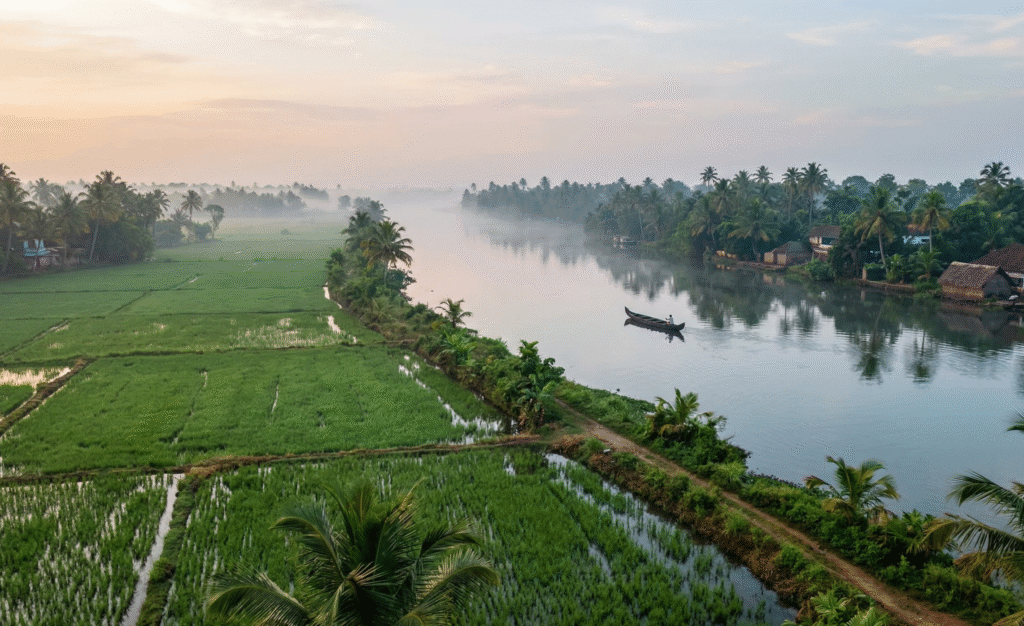
Step onto a kettuvallam as it pulls away from the jetty at dawn, and within minutes the noise of Alleppey town dissolves entirely. On both sides, coconut palms lean over glassy water. A toddy tapper climbs barefoot up a trunk fifty metres away. A purple heron lifts off from the reeds without a sound. This is the Alleppey backwaters — and no photograph has ever quite captured what it feels like to be in the middle of it.
Key Insights
- The Alleppey backwaters are a 900+ km network of canals, rivers, lakes, and lagoons — not a single spot, but an entire interconnected ecosystem along Kerala’s Malabar coast
- The best time to visit is November–February for clear skies, calm water, and migratory birdlife — but monsoon season (June–September) offers dramatic beauty, flooded paddies, and houseboat rates 30–50% lower
- You can explore by houseboat, shikara, kayak, canoe, or public ferry — each gives you access to a different layer of the backwaters
- Beyond the boats: the Nehru Trophy Boat Race (August), karimeen pollichathu (the backwaters’ signature dish), and Pathiramanal Island are experiences most visitors miss or underplan
- Alleppey (officially Alappuzha) is ~85 km south of Kochi — 1.5 hours by road or train
What Are the Alleppey Backwaters?
The Alleppey backwaters are a 900+ km network of canals, rivers, lakes, and lagoons running along Kerala’s Malabar coast, centred on Alappuzha district. This is not one body of water — it is an interconnected system that has shaped the landscape, economy, and culture of the region for centuries.
The geographic heart of the system is Vembanad Lake — the longest lake in India at 96.5 km, covering 2,033 square kilometres across Alappuzha, Kottayam, and Ernakulam districts. Vembanad is also a UNESCO Ramsar Wetland, internationally recognised for its biodiversity and ecological importance. From a boat in the middle of the lake, the shore disappears in every direction and it feels more like an inland sea than a lake.
A key structure that most visitors don’t know about: the Thanneermukkom barrier, a 1,252-metre causeway-dam that bisects Vembanad Lake, dividing it into a freshwater zone (east, towards Kuttanad) and a brackish water zone (west, towards Kochi). This division creates two distinct ecosystems — and is one reason the biodiversity here is so rich.
South of Alleppey town lies Kuttanad — the agricultural soul of the backwaters. Called the “Rice Bowl of Kerala,” Kuttanad is one of the only places on Earth where farming is done 1.2 to 3 metres below sea level, held back by an intricate network of dykes and pumps. The FAO (Food and Agriculture Organisation of the United Nations) recognised Kuttanad’s unique farming system as a Globally Important Agricultural Heritage System (GIAHS) in 2013 — one of very few such designations in South Asia. The emerald paddy fields you see from a boat heading south aren’t just scenery; they’re a living agricultural heritage system.
One more thing worth saying clearly: Alleppey and Alappuzha are the same place. Alappuzha is the official Malayalam name; Alleppey is the anglicised version that stuck from British rule. You’ll see both names on signs, tickets, and maps — they refer to exactly the same city and district.
How to Explore the Alleppey Backwaters: Your Boat Options
The boat you choose determines what you see. A kettuvallam gives you the open lake and village banks. A kayak takes you into narrow creeks where larger boats can’t go. The public ferry puts you in the middle of ordinary Keralite life. These aren’t interchangeable — each is a genuinely different experience, and the best visits combine two.
| Boat Type | Access Depth | Cost (approx.) | Best For | Noise Level |
|---|---|---|---|---|
| Houseboats | Main channels and lake | ₹6,000–₹60,000/night | Overnight immersion, couples, families | Low (engine off at moorings) |
| Shikara | Secondary waterways | ₹600–₹2,000/hr | Flexibility, smaller groups | Moderate (motorised) |
| Kayak | Narrow creeks and hidden canals | ₹750–₹1,500 (guided, 4 hrs) | Active travellers, photographers | Silent |
| Canoe | Narrow and mid-size waterways | ₹750–₹1,500 (guided, 4 hrs) | Gentle pace, wildlife spotting | Silent |
| Public Ferry | Main routes only | ₹15–₹50 per journey | Budget travel, local immersion | Moderate |
Houseboat (Kettuvallam)
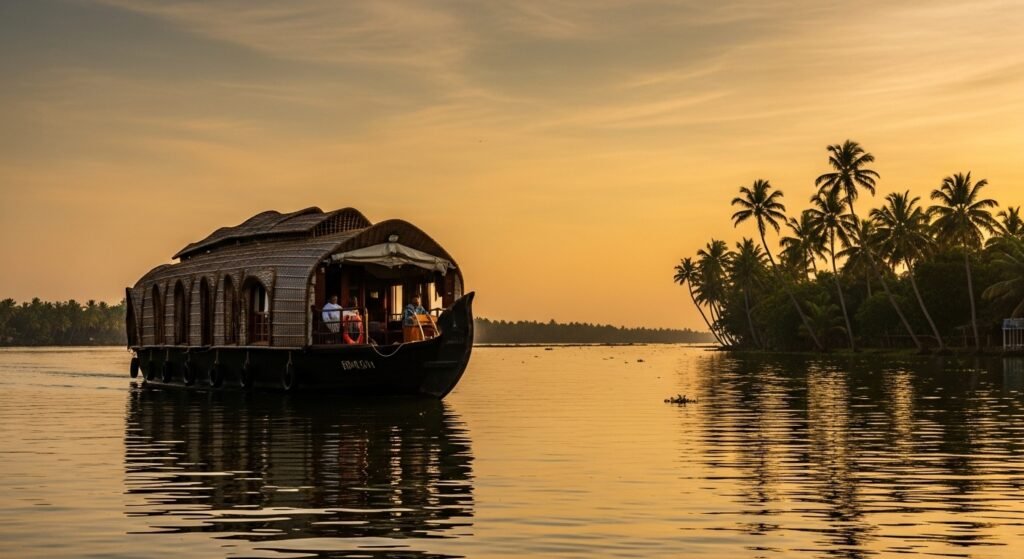
Houseboats are locally known as the kettuvallam is the iconic vessel of the Alleppey backwaters. The word is Malayalam: kettu means tied, vallam means boat — these traditional wooden craft were originally built to carry rice and spices along the waterways, assembled using bamboo, coir rope, and planks of cashew wood sealed with a paste made from black resin and coconut shell. They were the cargo ships of Kerala’s inland trade routes. Tourism converted them into floating guesthouses, but the best operators have kept the construction methods and materials largely intact.
A standard overnight stay includes a private crew — captain, chef, and oarsman — three full Kerala meals prepared onboard, a bedroom with en-suite bathroom, a covered sitting deck, and an open observation deck at the bow. You cast off around noon and moor for the night between 5:30pm and 6:30pm, when movement on the main channels is restricted. The morning departure (around 6am) gives you the most spectacular light of the stay.
Houseboats fall into three broad categories: Deluxe (basic but clean, ₹6,000–₹10,000/night), Premium (better finishes, ₹10,000–₹20,000), and Luxury (designer interiors, ₹20,000–₹60,000+). For most travellers, a well-maintained mid-range deluxe houseboat gives 90% of the experience for a third of the luxury price. Day cruises (6–7 hours, no overnight) start from around ₹4,000.
One important limitation to know: larger houseboats are restricted to the main channels and lake. They cannot access the narrow village canals. If seeing the deeper village landscape matters to you, combine your houseboat stay with a shikara or kayak excursion.
Shikara Boat
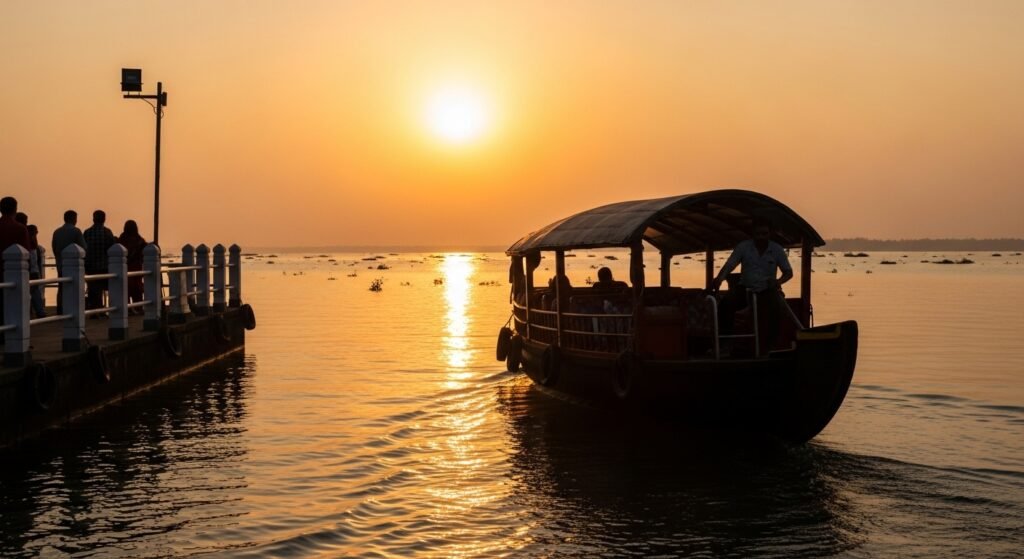
The shikara is the smaller, more manoeuvrable cousin of the kettuvallam — a motorised canopied boat that seats 4 to 15 people and can push into secondary waterways that houseboats can’t reach. It’s the bridge between the open-lake houseboat experience and the intimate canal access of a kayak.
Cost runs ₹600–₹2,000 per hour; negotiate for a half or full day and agree on the route before you set off. A good shikara captain will know which side-canals are worth turning into and which end at a dead post.
Kayaking the Alleppey Backwaters
Kayaking gives you the Alleppey that no other boat can. Paddling into a narrow creek that’s barely wider than the boat, with coconut palms forming a tunnel overhead and the sound of nothing but water and birds, is a fundamentally different experience from sitting on a houseboat deck watching the main channel pass by.
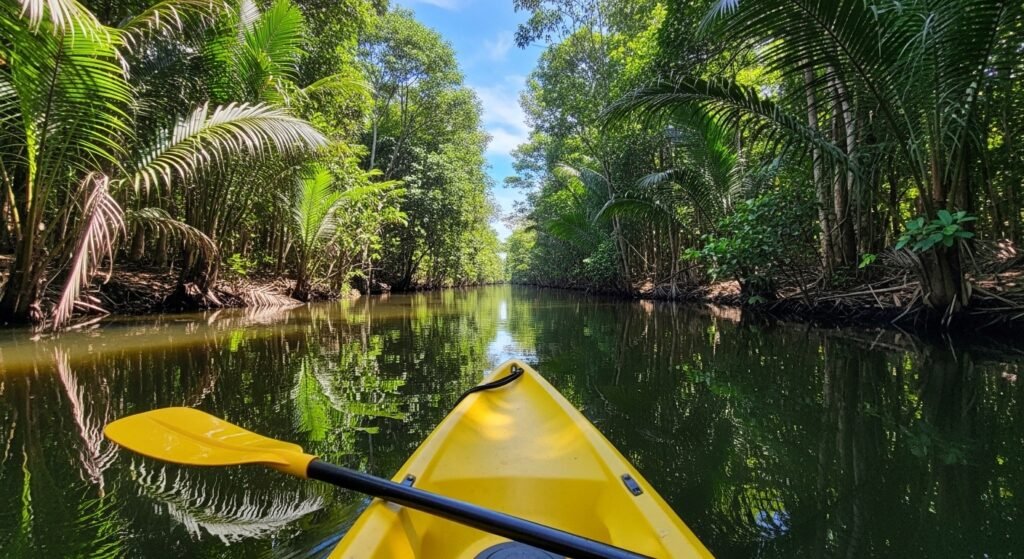
The canals accessible by kayak pass directly through villages — you’re at the same level as someone washing clothes on a stone step, or a child launching a paper boat from a doorway. It’s intimate in a way that a motorised vessel never is.
Nadodi Kayaking offers the best kayaking experience in Alleppey — guided tours into the narrow backwater channels, with routes designed to take you into areas that see almost no tourist traffic.
The best times are sunrise (6am–9am) and sunset (4pm–6:30pm) — golden light on the water and maximum birdlife activity at both ends of the day. Stick to November–February for ideal conditions: temperatures of 20–30°C, calm water, and the highest concentration of migratory birds. Guided tours are beginner-friendly and include life jackets and safety briefings.
Canoeing the Alleppey Backwaters
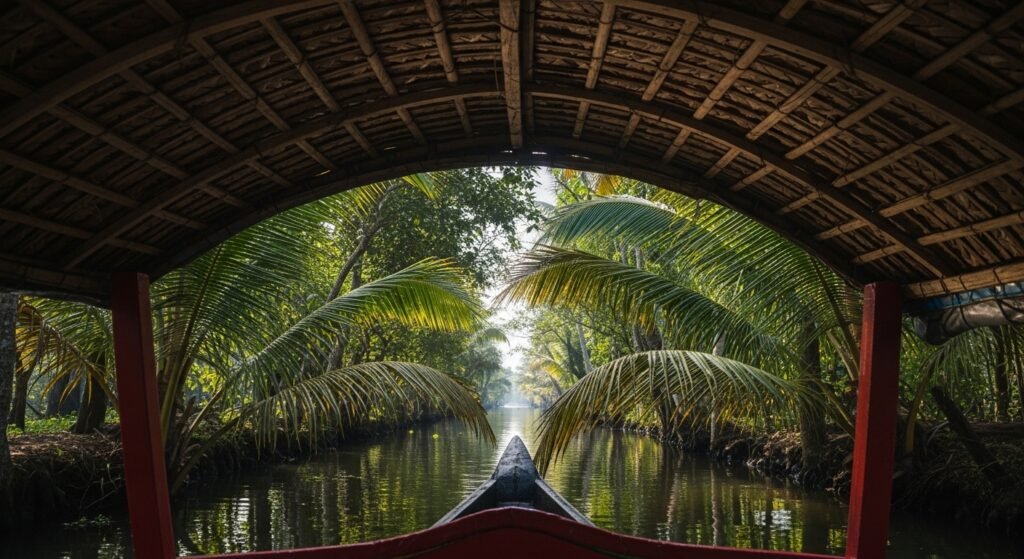
Canoeing offers a similarly silent, close-to-water experience as kayaking but with a more relaxed pace — suited to those who want the intimacy of a narrow canal without the physical exertion. Traditional dugout canoes (some motorised, some paddle-only) are the workhorses of village canal life, and getting into one puts you in the same vessel that backwater communities have used for generations.
Canoe tours access the same network of hidden creeks as kayak routes — the difference is pace and style. A paddled canoe is exceptionally quiet, which makes it ideal for wildlife watching in shallower sections where herons and kingfishers are most active. You can book your Alleppey village canoeing experience with us.
Public Ferry (SWTD)
The cheapest and most revealing way to see the backwaters is to travel them the way local people do — on a State Water Transport Department (SWTD) ferry.
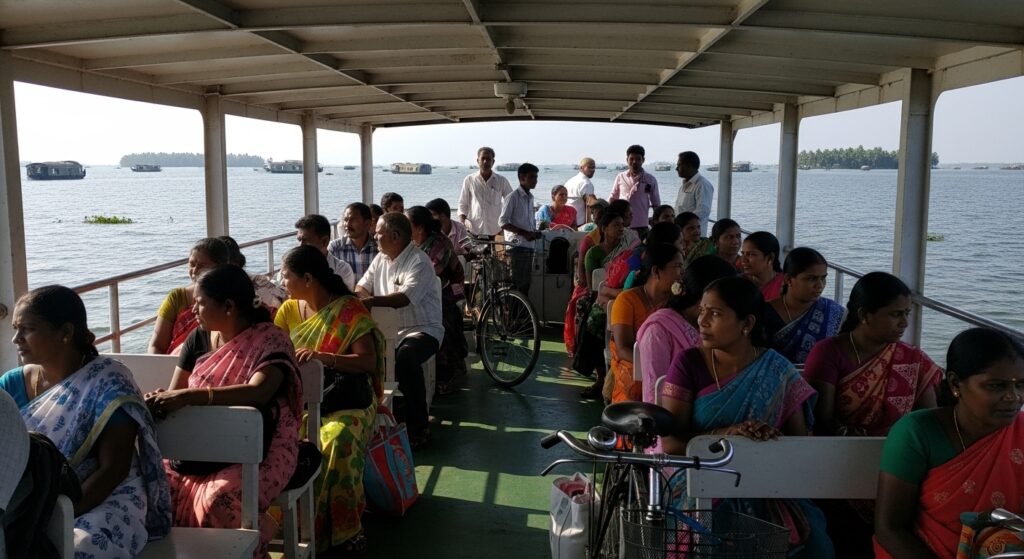
These government-operated boats run daily routes out of the central Alleppey boat jetty, carrying commuters, schoolchildren, market traders, and the occasional traveller who’s figured out the secret. A return journey to Kottayam costs around ₹33 and takes two hours each way — passing through Kuttanad’s paddy fields, village jetties where passengers board with baskets and bicycles, and open lake stretches where the horizon disappears.
Three routes are worth knowing:
- Nedumudy route — the most scenic, winding through narrow waterways and village canals; the closest thing to a free boat tour
- Kottayam route — two hours one way; ends at a school jetty in Kottayam; good for a there-and-back day trip
- Krishnapuram route — eight hours, passing Krishnapuram Palace; best combined with an overnight stay at Krishnapuram before returning
Timetables are on the SWTD website (swtd.kerala.gov.in). The Alleppey boat jetty is central — auto-rickshaws from the railway station or bus stand will get you there in under 10 minutes.
Other Things to Do in the Alleppey Backwaters
Watch (or Attend) the Nehru Trophy Boat Race
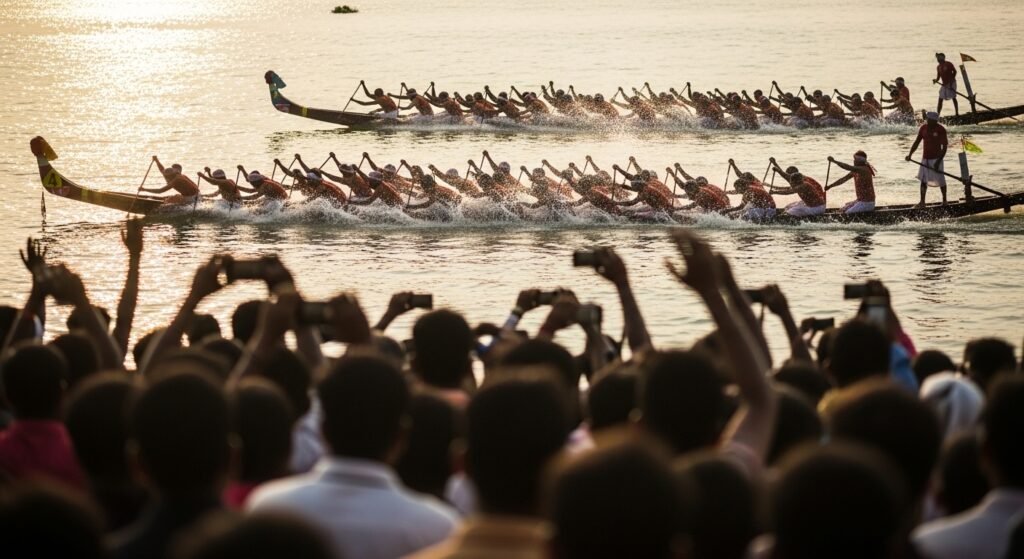
Every year on the second Saturday of August, Punnamada Lake — the Alleppey section of Vembanad — hosts one of India’s most spectacular sporting and cultural events.
The Nehru Trophy Boat Race began in 1952 when Jawaharlal Nehru visited Alleppey and was greeted by local fishermen in decorated kettuvallams. Nehru was so moved by the reception that he donated a trophy for an annual competition. The winning crew was carried on the Nadubhagam Chundan — a traditional snake boat that has since become part of the race’s founding story. What started as a spontaneous welcome has grown into an event that draws over 200,000 spectators.
The boats are chundan vallams — snake boats measuring 100–120 feet long, with a raised serpent-head prow and powered by 90 to 110 oarsmen rowing in perfect synchrony to the rhythm of traditional vanchipattu songs and drumbeats. The sight and sound of a full fleet of chundan vallams turning into a racing stretch is genuinely like nothing else.
Practical: accommodation in Alleppey books out months ahead for August. Grandstand tickets are available through the Nehru Trophy committee. Book accommodation at least three months ahead if the race is the reason for your trip.
Worth knowing: The Champakulam Moolam Boat Race, held in July at Champakulam village (on the Pampa River), is actually the oldest boat race in Kerala — it predates the Nehru Trophy and is a far more intimate, deeply local event. If you’re in the region in July, it’s worth the trip.
Eat Karimeen Pollichathu
Karimeen — the pearl spot fish — is Kerala’s state fish and the signature species of Vembanad Lake. It thrives in the brackish water of the backwaters and appears on every good menu in Alleppey. But there is one preparation that defines it: karimeen pollichathu — the fish scored, marinated in a red chilli and coconut masala paste, wrapped tightly in a banana leaf, and pan-grilled until the leaf chars slightly and the fish steams inside its own juices.
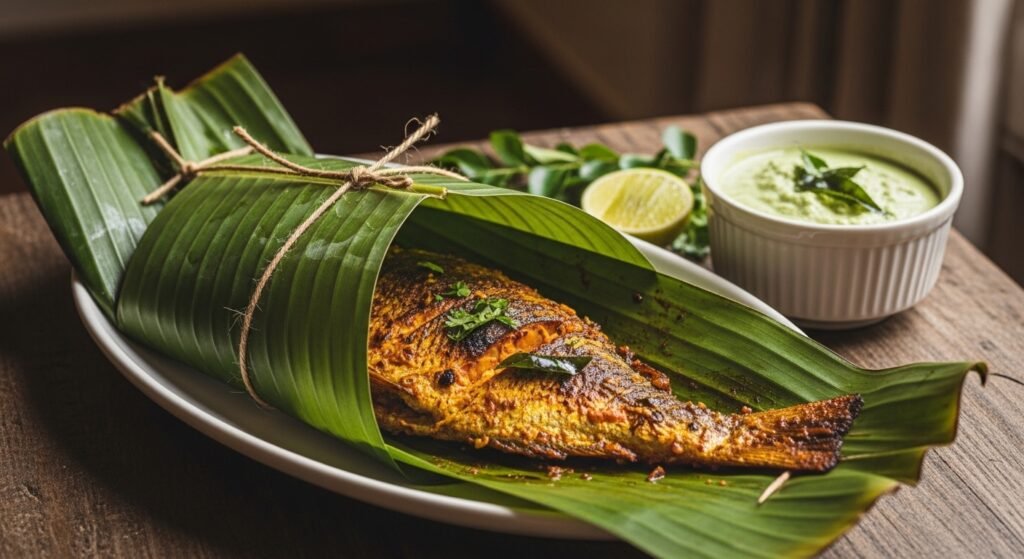
The result is extraordinarily aromatic and specific — the earthiness of the banana leaf, the heat of the masala, the firm white flesh of a fish pulled from the same water you’ve been floating on. You can’t eat this better anywhere else in India, because the fish doesn’t travel.
If you’re on a houseboat, request karimeen pollichathu specifically when you book — your chef will need to source fresh catch locally. Don’t assume it will automatically be on the menu. Eat it with appam or matta rice.
Explore Pathiramanal Island
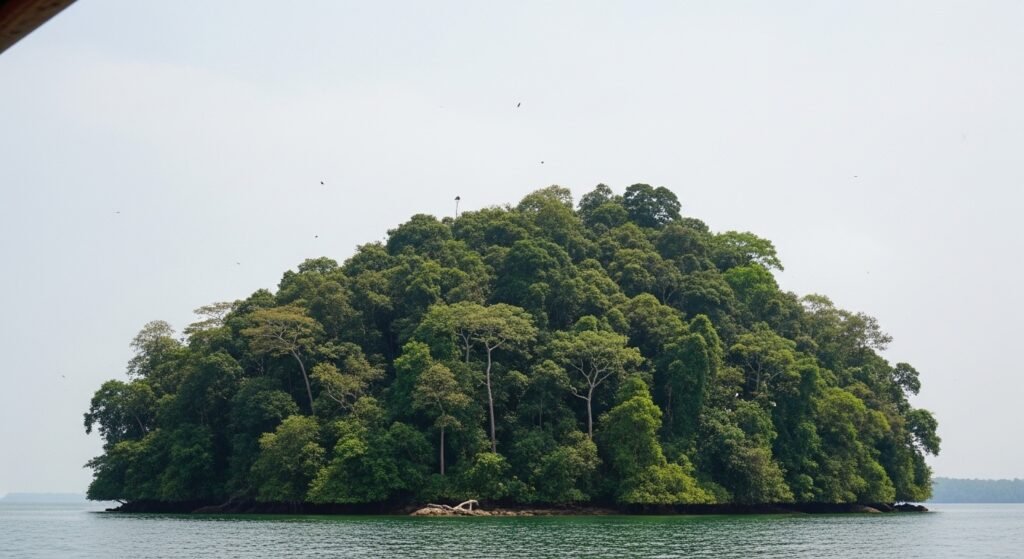
Pathiramanal means “sands of midnight” in Malayalam — a small, boat-access-only island sitting in the middle of Vembanad Lake, reached by a 30-minute shikara or ferry ride from the Alleppey jetty.
The island is a bird sanctuary hosting over 10 species of resident and migratory birds. November to February brings migratory arrivals — Siberian pintails, garganeys, and other wintering waterfowl join the resident kingfishers, purple herons, cormorants, and egrets. The shore is quiet, the sand is white, and there is almost no tourist infrastructure — just trees, birds, and the sound of the lake.
Most houseboat itineraries can be routed to stop at Pathiramanal. If yours doesn’t, it’s worth arranging a separate shikara trip.
Visit the Kuttanad Paddy Fields
Heading south from Alleppey by any boat, the paddy fields of Kuttanad open up on both sides — vast emerald carpets growing in fields that sit below the water level you’re floating on. The dykes holding the water back from the crops are visible from the boat. It’s a slightly vertiginous geography when you understand what you’re looking at.
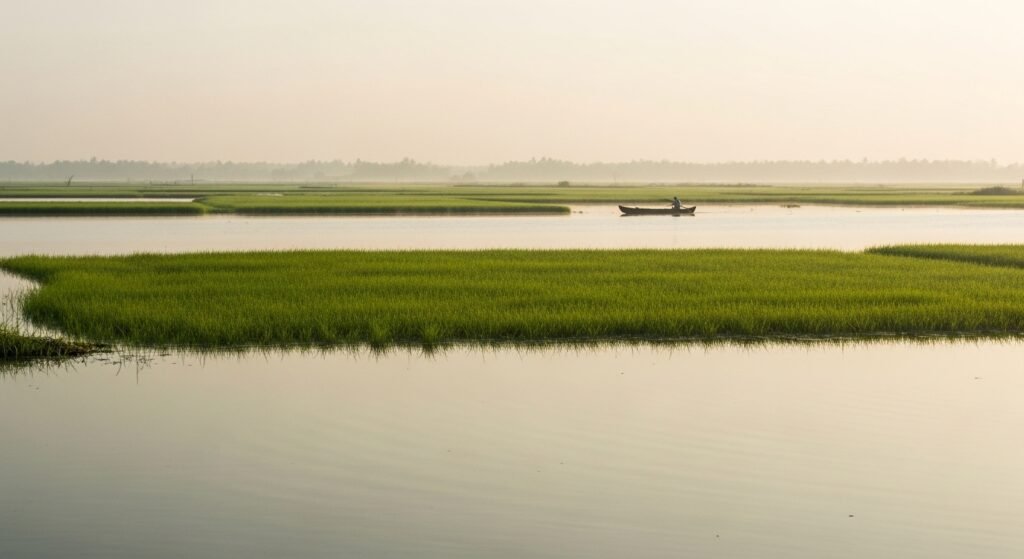
This landscape has been shaped over centuries by Kuttanad’s farmers, who have developed one of the world’s most sophisticated below-sea-level agricultural systems. The FAO’s GIAHS designation in 2013 formally recognised what the region has always known: this is a globally rare way of living with water, not against it.
The best time to see the paddies at full green intensity is October–January (post-monsoon to mid-harvest). A shikara or kayak into the agricultural canals south of Alleppey town gets you closest.
See the Alappuzha Lighthouse
Built in 1862 and standing 30 metres tall at the edge of Alappuzha Beach, the lighthouse is one of the best elevated vantage points in Alleppey — and one of the most undervisited. Climb the old teak staircase, which has been in continuous use for over 160 years, and the view from the top takes in the Arabian Sea to the west and the backwater lagoons to the east simultaneously.
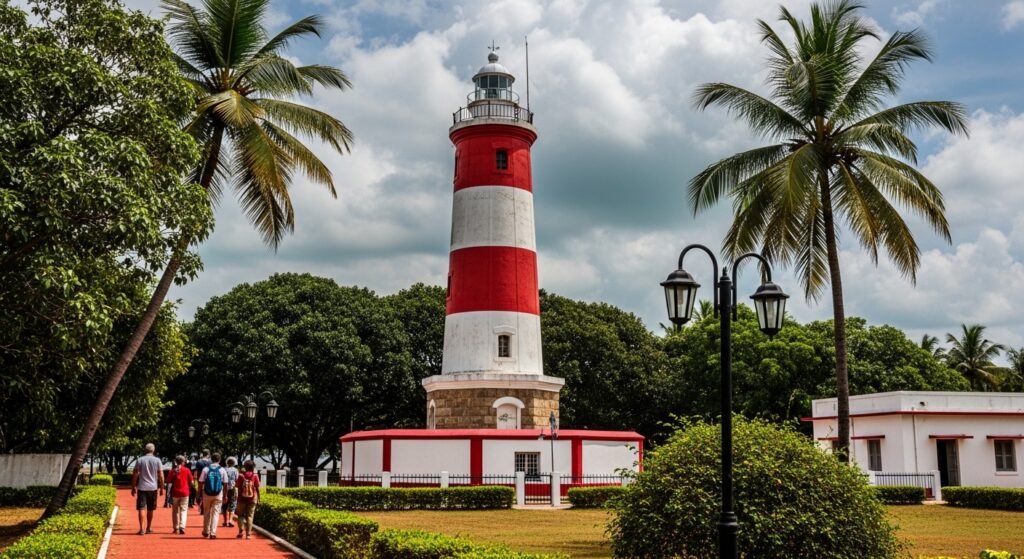
Entry: ₹50 for foreign visitors, ₹10 for a photography permit. Open Tuesday to Sunday, 9am–11:45am and 2pm–5:30pm; closed Mondays and public holidays. Combine it with an afternoon at Alappuzha Beach next door and stay for sunset.
Experience the Backwaters After Dark
Most visitors experience the backwaters almost entirely in daylight. The night is different.
Houseboats moor between 5:30pm and 6:30pm, when movement on the main channels stops. As the engine cuts and the boat stills, the sounds that were underneath the motor noise emerge: frogs along the canal banks, the slow drip of water off an oar, oil lamps flickering in a fishing village across the water, fireflies tracking low arcs over the reeds. On very dark nights, far from town, the sky over Vembanad is genuinely extraordinary.
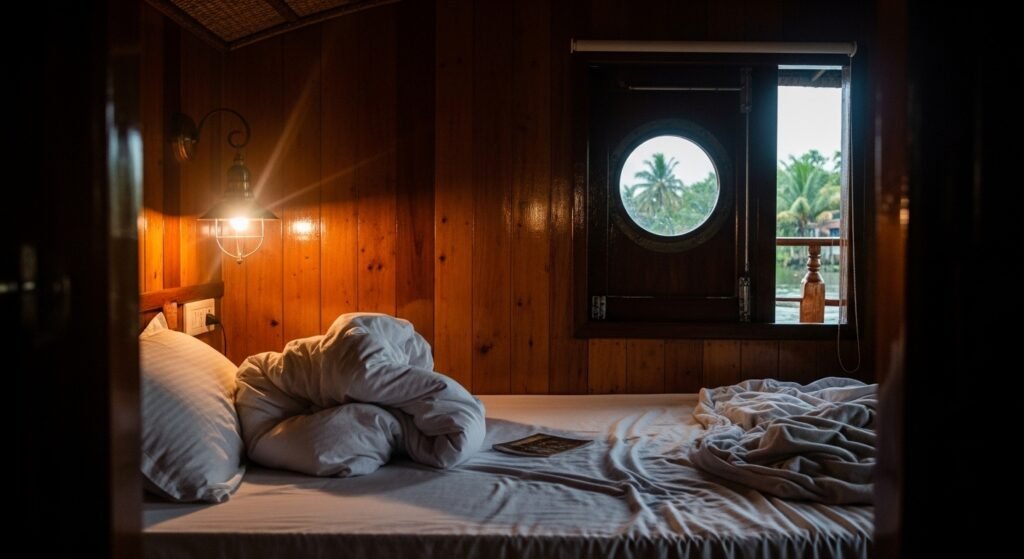
The night on a houseboat isn’t an activity — it’s an atmosphere. It’s what separates a night on the water from a day cruise, and it’s the part most people remember longest.
Taste Toddy (Kallu) at a Local Shop
Toddy — kallu in Malayalam — is fresh palm wine tapped from the flower stems of coconut palms. A trained toddy tapper (kallu shaappu owner) climbs the palm barefoot before dawn, cuts the flower stem, and collects the sap in a clay pot. In the morning it is sweet and barely alcoholic. By afternoon, naturally fermenting in the heat, it reaches 4–6% alcohol and takes on a slightly sour, yeasty character. By evening it’s quite strong.
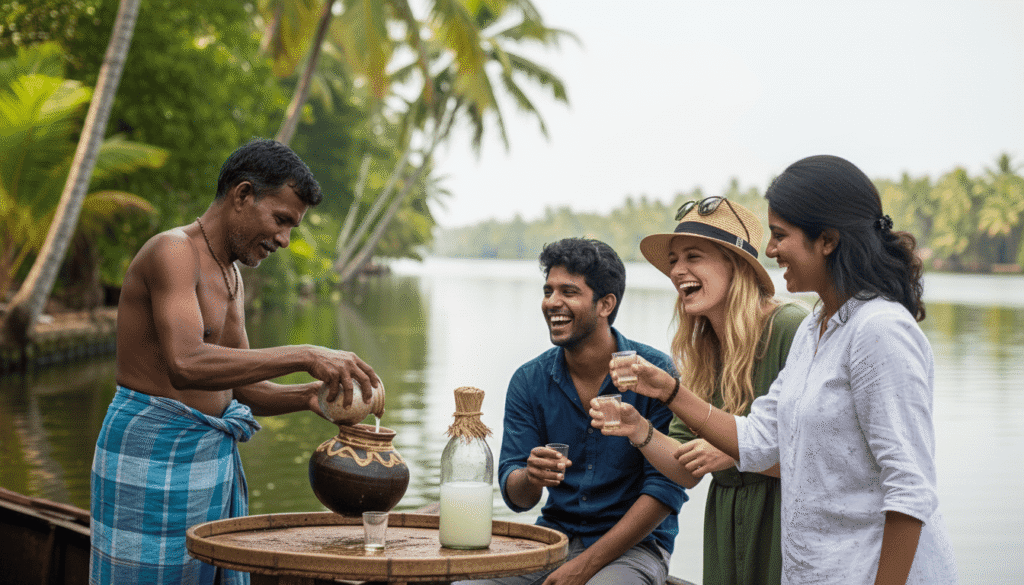
Toddy shops (kallu shaappu) are found throughout the backwater villages, usually open from mid-morning to early evening. The experience: a wooden bench, metal or clay cups, and a plate of fried karimeen or spiced kappa (tapioca) alongside. It costs almost nothing and is among the most genuinely local things you can do in Alleppey.
It is an acquired taste. Start with the morning variety if you want it mild.
Watch Coir Being Made
The Alleppey district has been India’s primary coir (coconut fibre) manufacturing region for over a century — at its peak, it was known as the “Coir Capital of the World.” The process is still visible throughout backwater villages: coconut husks are soaked in retting pits (shallow water channels) for several months until the fibres soften; they’re then spun into yarn on wooden spinning wheels and woven into rope, mats, and matting.
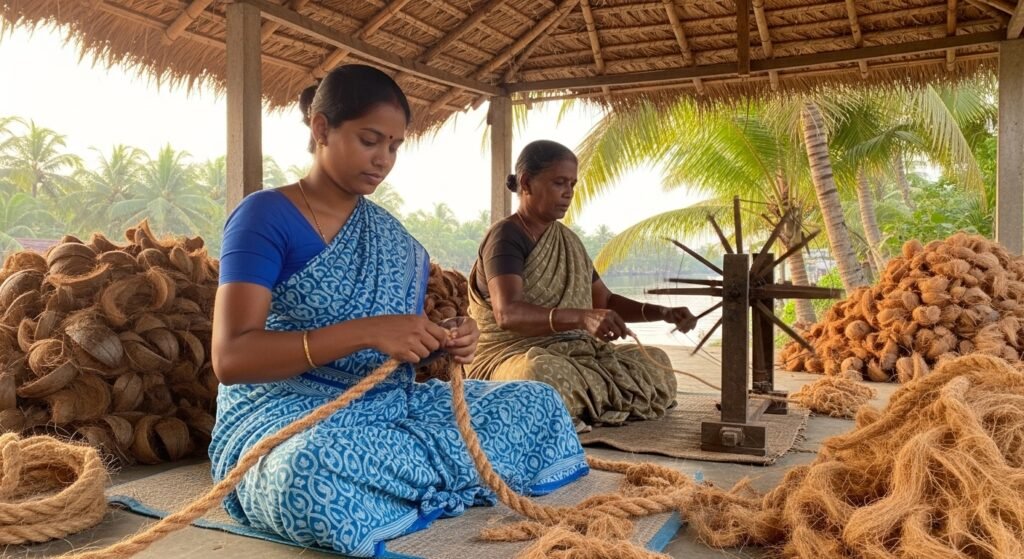
From a shikara or kayak through the village canals, you’ll see the retting pits, the spinning wheels turning outside doorways, and stacks of finished coir products waiting for collection. It’s a living cottage industry — not a museum exhibit — and passing through quietly by canoe is the best way to see it without intruding.
Visiting Alleppey During Monsoon: The Case for Going in the Rain
Most travel guides treat the monsoon (June–September) as a footnote — a season to note and advise against. This is a mistake.
The Alleppey backwaters during monsoon are genuinely, dramatically beautiful in a way that the peak season simply isn’t. Here’s what actually happens when the rain comes:
The landscape transforms completely. The paddy fields of Kuttanad flood and the dykes disappear beneath the water. The rice grows visible above the surface in bright, almost electric green. Coconut palms turn a deeper, saturated shade that photographs unlike anything in the dry season. The sky does extraordinary things — heavy cumulus clouds rolling off the Arabian Sea, sudden breaks of gold light through grey, double rainbows over the lake.
The water rises. Vembanad fills. Canals that are shallow in winter become navigable in monsoon. Villages that sit above the canal banks in December are surrounded by water in July, and the boats become the only way in.
The boats are almost empty. Mass tourism largely retreats between June and September. The houseboat you share the main channel with in February — one of dozens visible at any moment — is one of perhaps four in monsoon. You can have stretches of the backwaters entirely to yourself.
The price drops significantly. Houseboat rates fall 30–50% during monsoon season across most operators. The same kettuvallam that costs ₹12,000 a night in December may be ₹7,000–₹8,000 in July.
What you should know before going: Some houseboat operators reduce their fleet or suspend services during heavy monsoon weeks (late June through early August being the most intense). A handful of activities, including kayaking in exposed sections, are better avoided in peak rainfall. Ferry services occasionally adjust routes. Check conditions with operators before travel, specifically for the weeks around the monsoon peak.
The sweet spot for monsoon travel is late September to mid-October — the rain is easing, the landscape is at maximum lushness, water is high, prices are still shoulder-season low, and tourist numbers haven’t yet returned. Locals will tell you it’s the most beautiful time of year. They’re not wrong.
Alleppey Backwaters Itineraries
1-Day Backwaters from Kochi
Take the early morning train from Ernakulam Junction to Alappuzha (departs ~7am, arrives ~8:30am, ₹30–₹80). Book a half-day shikara tour from the jetty (4–5 hours, ₹2,500–₹4,000 for the boat) through the village canals and towards Kuttanad. Back in Alleppey town by early afternoon — lunch at a local restaurant (karimeen pollichathu if they have it). Walk to Alappuzha Lighthouse for the 2pm opening; climb and see the view. Ten-minute walk to Alappuzha Beach for the late afternoon and sunset. Train back to Kochi (~6pm departure). This is a full, honest day — not exhausting, and genuinely satisfying.
2-Night Immersive Backwaters Stay
Day 1: Arrive Alleppey by midday. Check into a backwater-facing homestay or boutique resort on Vembanad Lake. Afternoon: guided kayaking tour with Nadodi Kayaking (sunset slot, 4pm–6:30pm). Evening: dinner at a local restaurant in town.
Day 2: Houseboat check-in at noon. Sail through the afternoon: Vembanad Lake, Kuttanad paddy fields, Pathiramanal Island if your route allows. Moor for the night by 6pm. Dinner onboard (request karimeen pollichathu). Evening on the open deck — the dark, the frogs, the fireflies. Sunrise on deck the next morning.
Day 3: Houseboat check-out by 9am. Morning: Alappuzha Lighthouse. Late morning: SWTD ferry to Nedumudy for the scenic village canal route (₹15–₹20 one way). Back to Alleppey by early afternoon. Depart for next destination.
3-Day Slow Travel Itinerary
Day 1: Arrive, explore Alleppey town on foot — the Dutch-era canal bridges, the old harbour area, the market. Afternoon: canoeing tour through the village canals (book through alleppey.life). Evening: find a kallu shaappu in a nearby village for toddy and fried fish.
Day 2: Full-day SWTD ferry journey — take the Krishnapuram route (8 hours) south through the Kuttanad backwaters to Krishnapuram, with its 18th-century palace. Stay overnight near Krishnapuram.
Day 3: Return to Alleppey by ferry or taxi. Houseboat check-in at noon; overnight stay on Vembanad Lake. Pathiramanal Island stop, open-lake sailing, Kuttanad paddy field views. Check-out next morning.
Best Time to Visit the Alleppey Backwaters
November–February (peak season): The most comfortable and popular window. Temperatures settle between 20–30°C, skies are clear, and the backwaters are at their calmest. Migratory birds arrive at Pathiramanal Island and Kumarakom from November onwards. The water is clear enough to see the bottom in shallower sections. Houseboats and all activities are fully operational. Expect the highest prices and the most boats on the water — book ahead.
March–May (shoulder/transition): Still dry, increasingly hot. March is pleasant; April and May push 35–40°C+ and daytime boating becomes genuinely uncomfortable. Early mornings and evenings are still good. Fewer tourists than peak, with slightly lower rates. Avoid the midday sun.
June–September (monsoon): See the full section above. The most dramatic time visually, the cheapest for accommodation, and the least crowded. Some logistical complexity — verify operator availability before you go. Late September is the sweet spot.
October (shoulder/underrated): The monsoon eases, the landscape is at full post-rain lushness, water levels are still high, and tourist numbers haven’t returned. Increasingly popular among travellers who know about it. Good value, excellent conditions. One of the best months to visit Alleppey if you can be flexible.
| Month | Temp (°C) | Crowd Level | Houseboat Availability | Best For |
|---|---|---|---|---|
| Nov–Feb | 20–30 | High | Full | All activities, birdwatching, comfort |
| Mar–Apr | 30–38 | Medium | Full | Budget travel, fewer crowds |
| May | 35–40+ | Low | Most available | Early morning/evening only |
| Jun–Aug | 26–32 | Very Low | Reduced | Monsoon landscape, value |
| Sep–Oct | 26–30 | Low–Medium | Most available | Post-monsoon beauty, value |
How to Reach the Alleppey Backwaters
From Kochi (most common gateway): Alleppey is 85 km south of Kochi — roughly 1.5 hours. Train is the best option: from Ernakulam Junction to Alappuzha station, ₹30–₹80 depending on class, multiple services daily. A taxi runs ₹1,800–₹2,500. The nearest international airport is Cochin International Airport (COK), which connects to major Gulf cities, Singapore, London, and domestic hubs.
From Trivandrum: 155 km north; approximately 3 hours by road or train. Direct trains run on the Thiruvananthapuram–Alappuzha route.
From Kottayam: 60 km west; 1.5 hours by road, or take the SWTD public ferry (2 hours, ₹33 — a scenic option in itself).
Once in Alleppey: Alappuzha railway station and the main bus stand are both about 3–4 km from the central boat jetty. An auto-rickshaw between any of these points costs ₹60–₹100. The boat jetty is your operational base — houseboat check-ins, shikara hire, and SWTD ferry departures all originate here.
Alleppey Backwaters vs Kumarakom
Both Alleppey and Kumarakom sit on the same lake — Vembanad. The water is the same. The difference is everything around it.
Choose Alleppey if: you want the full backwaters experience layered with a real town — beaches, a lighthouse, local restaurants, public ferries, independence, and access to the Nehru Trophy Boat Race. Alleppey suits travellers who want to move between things rather than settle into one place.
Choose Kumarakom if: you want a quieter, more resort-focused experience centred on Vembanad Lake, with the Kumarakom Bird Sanctuary (part of Kottayam district) as the nature draw. Kumarakom has less independent infrastructure — it’s built around the resort stays.
The honest answer: if you have one night on the backwaters, Alleppey gives you more options around the water experience. If you have two or three nights and want something more secluded and retreat-like, Kumarakom earns its place. Many visitors do both — Alleppey first, Kumarakom second, or vice versa, with a short boat ride or taxi between them.
Wildlife and Nature in the Alleppey Backwaters
Birds: The backwaters support a rich year-round resident bird population — purple herons, kingfishers, cormorants, little egrets, and Indian darters are seen almost every time you’re on the water. Pathiramanal Island and Kumarakom Bird Sanctuary (15 km from Alleppey) bring in migratory species from November: Siberian pintails, garganeys, teals, open-billed storks, and Brahminy kites among them. Early morning, especially from a silent kayak or canoe, is when you see the most.
Fish: Karimeen (pearl spot, Etroplus suratensis) is the signature fish of Vembanad Lake and Kerala’s state fish. It thrives in the brackish backwater conditions and is the basis of karimeen pollichathu. Fishing from houseboats is possible — ask your crew the night before. You’ll also see prawn nets strung across canal mouths and crab traps checked at dawn from small wooden boats.
Flora: Coconut palms line every bank. Water hyacinth covers the shallower still sections in thick floating mats. Lotus flowers appear in the agricultural canals of Kuttanad. The paddy fields of Kuttanad turn the south a uniform intense green from July through January.
Ecosystem: Vembanad’s Ramsar designation reflects its global significance as a wetland — the fresh/brackish divide created by the Thanneermukkom barrier supports two distinct fish and plant communities in a single lake system.
Practical Tips for the Alleppey Backwaters
Combine boat types. A houseboat gives you the lake and the night; a kayak or shikara gives you the narrow canals the houseboat can’t reach. They’re not substitutes — they’re complementary. Plan for both if you have two or more days.
Tell your chef what you want. If karimeen pollichathu matters to you, say so when booking. Houseboats prepare meals from what they’ve sourced before departure — last-minute requests may mean a less fresh version or a substitute. Specify it in advance.
Time your lighthouse visit. The lighthouse closes at 5:30pm and is shut on Mondays. Go Tuesday–Sunday after 2pm, climb, then walk directly to the beach for sunset. That’s two things done in sequence with minimal effort.
Use the SWTD website. Timetables for all ferry routes out of Alleppey are on swtd.kerala.gov.in. The Nedumudy and Kottayam routes are the most rewarding for first-time visitors.
Book ahead in peak season. November–February houseboat availability drops fast, especially on weekends. For the Nehru Trophy weekend in August, book accommodation three to four months ahead — the entire town fills.
Pack for the water. Sunscreen and insect repellent are essential (mosquitoes build near reeds from late afternoon). Lightweight cotton dries fast and breathes on the water. A light layer for houseboat evenings is useful even in winter — it cools quickly once the sun goes.
Bargain on private boats. Shikara and private boat prices are negotiable, especially outside peak season. Agree on the route and duration before departure. Ask specifically whether the price includes the captain’s fuel — some operators add this at the end.
Frequently Asked Questions About the Alleppey Backwaters
What are the Alleppey backwaters?
The Alleppey backwaters are a 900+ km network of canals, rivers, lakes, and lagoons running through Kerala’s Alappuzha district, centred on Vembanad Lake — the longest lake in India and a UNESCO Ramsar Wetland. This isn’t one destination but an entire interconnected landscape shaped by centuries of rice and spice trade. The backwaters are experienced from the water itself — by houseboat, kayak, shikara, or public ferry.
Are Alleppey and Alappuzha the same place?
Yes, completely. Alappuzha is the official Malayalam name of the city and district; Alleppey is the anglicised version used during British rule that remains in common English usage. Both names appear on signs, train tickets, and maps — they refer to the same place.
How much does a houseboat cost in Alleppey?
Alleppey houseboats (kettuvallams) range from approximately ₹6,000 per night for a basic deluxe category to ₹60,000+ for luxury vessels. A well-maintained deluxe houseboat for two with all meals typically falls between ₹8,000–₹12,000. Day cruises (6–7 hours) start from around ₹4,000. Prices drop 30–50% during monsoon season (June–September).
When is the best time to visit the Alleppey backwaters?
November to February offers the most comfortable conditions — 20–30°C, clear skies, full houseboat availability, and migratory birds. October is an underrated shoulder month with post-monsoon lushness and lower prices. Monsoon (June–September) is the most dramatic visually and the most affordable — but verify operator availability before travelling. Avoid April–May if possible; 40°C+ heat makes daytime boating genuinely uncomfortable.
What is the Nehru Trophy Boat Race?
The Nehru Trophy Boat Race is an annual snake boat race held on the second Saturday of August at Punnamada Lake in Alleppey. It began in 1952 when Jawaharlal Nehru visited Alleppey and the local fishermen raced their decorated boats to welcome him — he donated a trophy and an annual tradition was born. Today, chundan vallams (snake boats) of 100–120 feet powered by 90–110 oarsmen compete before over 200,000 spectators in one of India’s largest sporting spectacles.
Are houseboats worth it in Alleppey?
For most first-time visitors, yes. A night on a kettuvallam gives you direct access to the backwater landscape at dawn and dusk — breakfast on an open deck, the sounds of village life from the canal banks, the stillness after the engine cuts at mooring. This is not replicable from land. The value question is about category: a mid-range deluxe houseboat gives the full experience at a fraction of the luxury price. If budget is the real constraint, a half-day shikara tour combined with the SWTD public ferry covers the landscape for under ₹2,000.
Can you visit Alleppey as a day trip from Kochi?
Yes — it’s one of the most popular day trips from Kochi, and genuinely worthwhile. The train takes 1.5–2 hours from Ernakulam Junction (₹30–₹80). A half-day shikara tour from the jetty, the Alappuzha Lighthouse, and the beach can all be done in a single day. The limitation is that the best backwater experience — especially the light at dusk and the night mooring — requires an overnight stay. A day trip works; it just shows you the surface.
What wildlife can you see in the Alleppey backwaters?
Year-round residents include purple herons, kingfishers, cormorants, little egrets, and Indian darters. November to February brings migratory species — Siberian pintails, garganeys, teals, and open-billed storks — to Pathiramanal Island and Kumarakom. The backwaters are home to karimeen (pearl spot), Kerala’s state fish and the star of karimeen pollichathu. Otters are occasionally seen in narrower canals. Kayaking or canoeing in the early morning gives you the best chance of close wildlife encounters.
What is Kuttanad?
Kuttanad is the agricultural sub-region directly south of Alleppey town, spanning Alappuzha and Kottayam districts. It’s called the “Rice Bowl of Kerala” and is one of the only places on Earth where farming is done 1.2–3 metres below sea level. In 2013, the FAO designated Kuttanad’s farming system a Globally Important Agricultural Heritage System (GIAHS). The flooded paddy fields visible from any boat heading south from Alleppey are not just scenery — they’re a living agricultural heritage recognised as globally unique.